

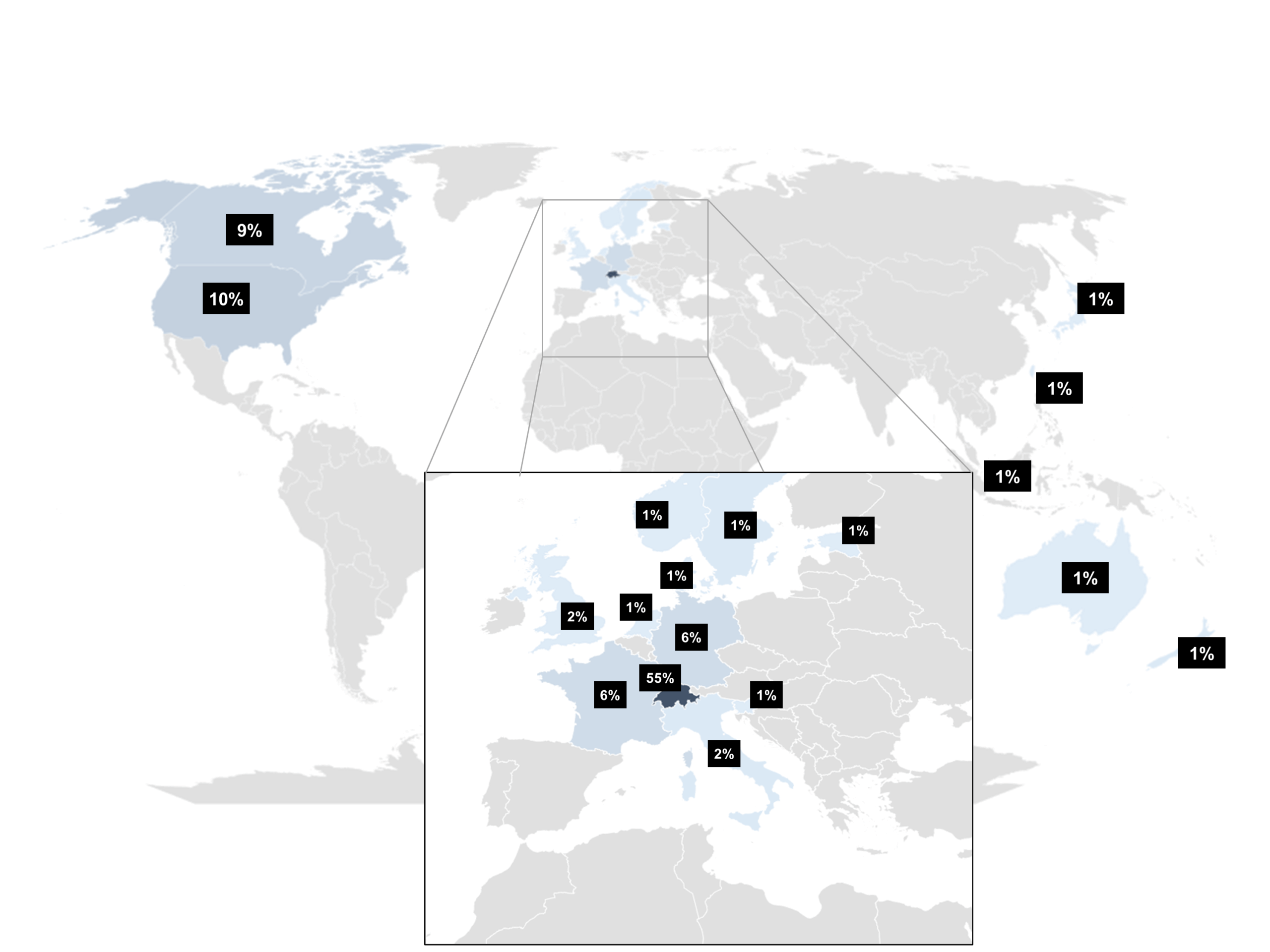
Between June and August 2025, we conducted the Global Pumpfoiling Survey for the fourth time. This time, 131 participants shared their exerience and responses with us. The group was notably diverse, representing 19 different countries, all genders, and various age groups.
As pumpfoiling continues to grow as a sport, it is important to note that the feedback we collected may not fully represent the global communities opinion. For certain questions, a larger sample size would have been beneficial to reflect the perspectives of pumpfoilers worldwide. Still, the results provide valuable insights into how the sport is evolving and allows to derive trends.
Selection of Key Findings from the 2025 Survey
- On average, it took our participants 376 starts before they could pumpfoil for 30 seconds.
- The dock start from a standing position is the most popular starting method. This technique is most often mentioned by pumpfoilers who needed relatively few attempts to learn pumpfoiling.
- Half of all survey participants can pumpfoil continuously for more than 80 seconds
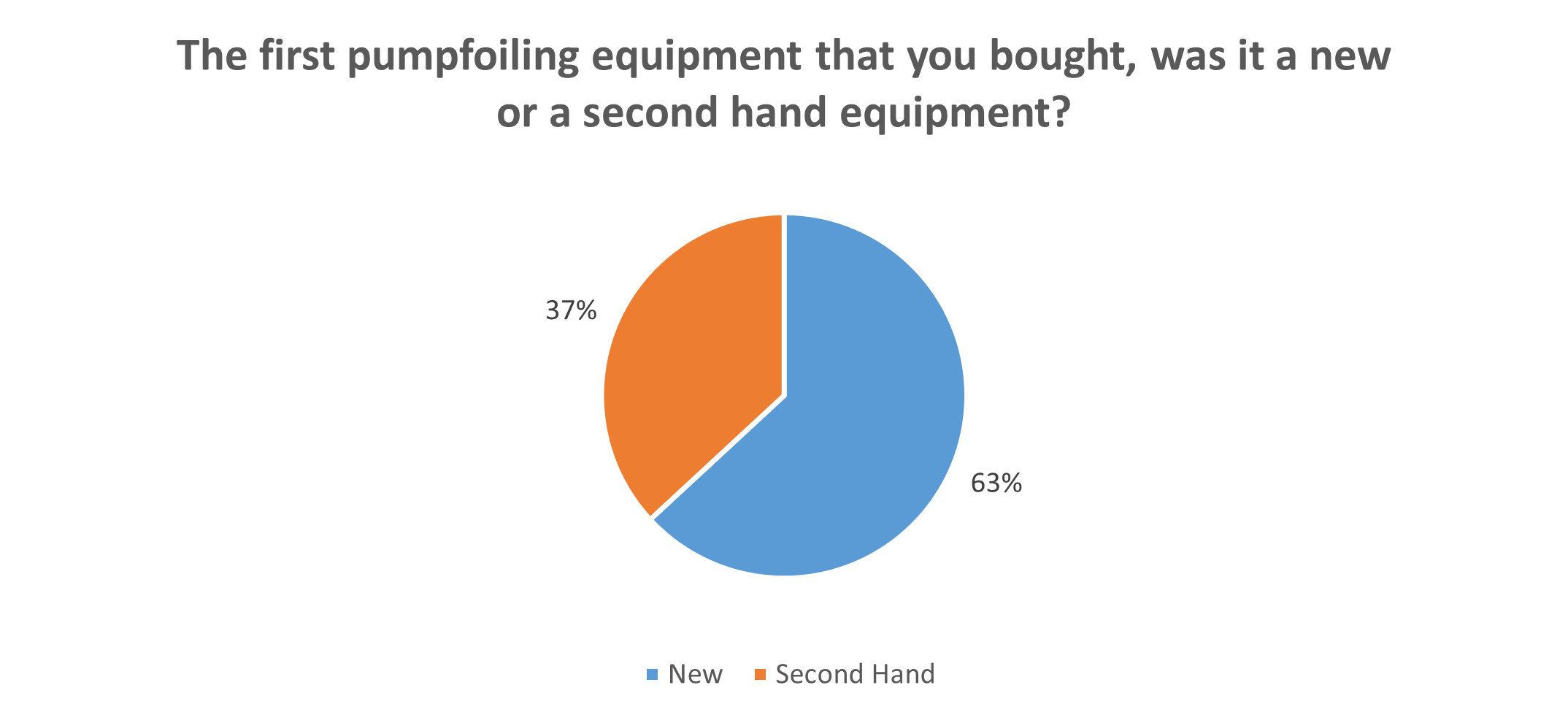
- 95% of participants own their own equipment. One third acquired their first equipment second-hand.
- Most participants switch from beginner foils to a new foil within less than 12 months
- Around 45% of participants also changed brands when changing the foil
- 55% reported that they at least sometimes use protective gear; 45% of participants have already experienced an accident while pumpfoiling.
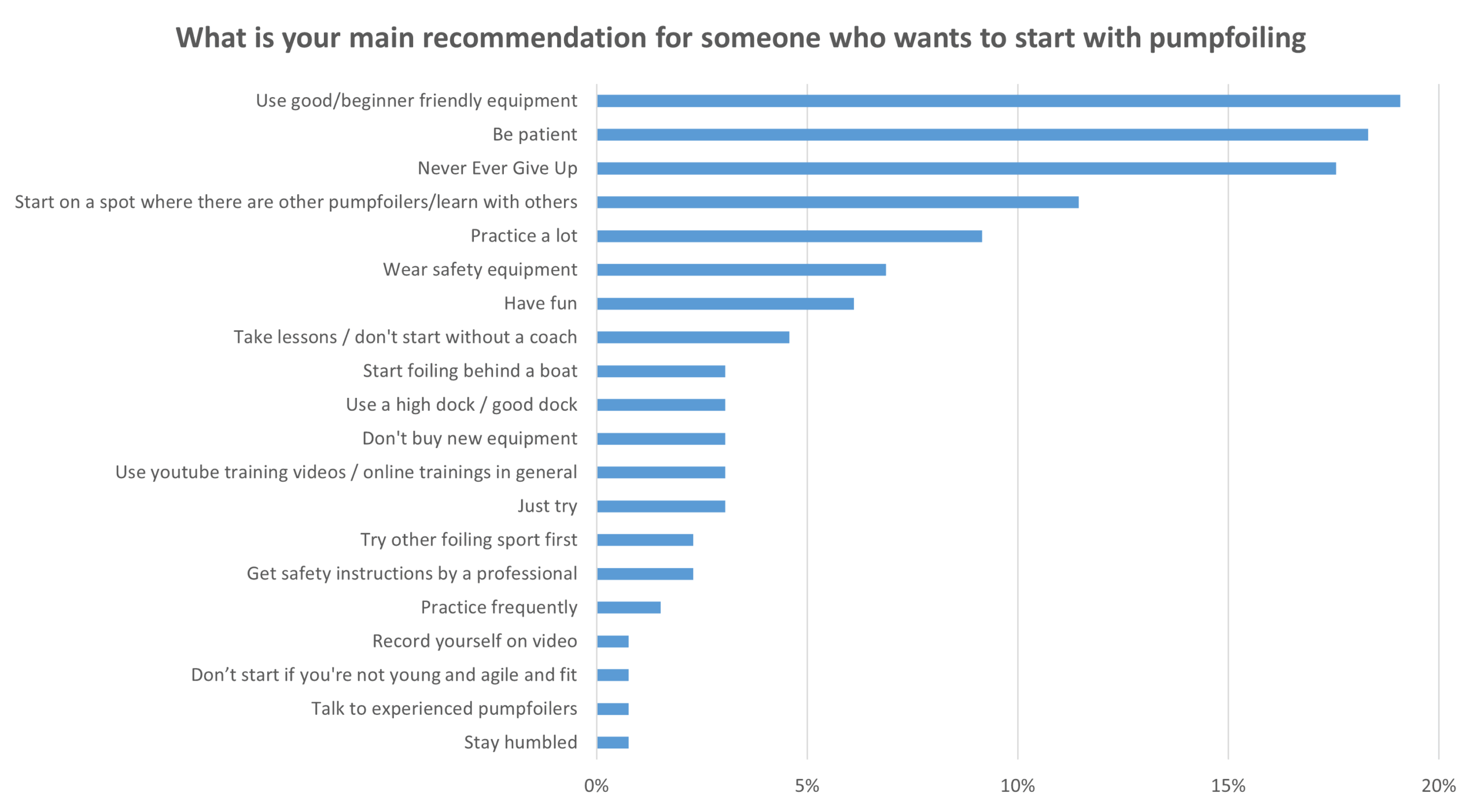
- Beginner-friendly/good equipment was most frequently mentioned as a recommendation for newcomers
Now let us take a closer look at the results in detail, starting with the demographic distribution of the survey participants, as this may have influenced the answers to some of the questions.
Survey participants
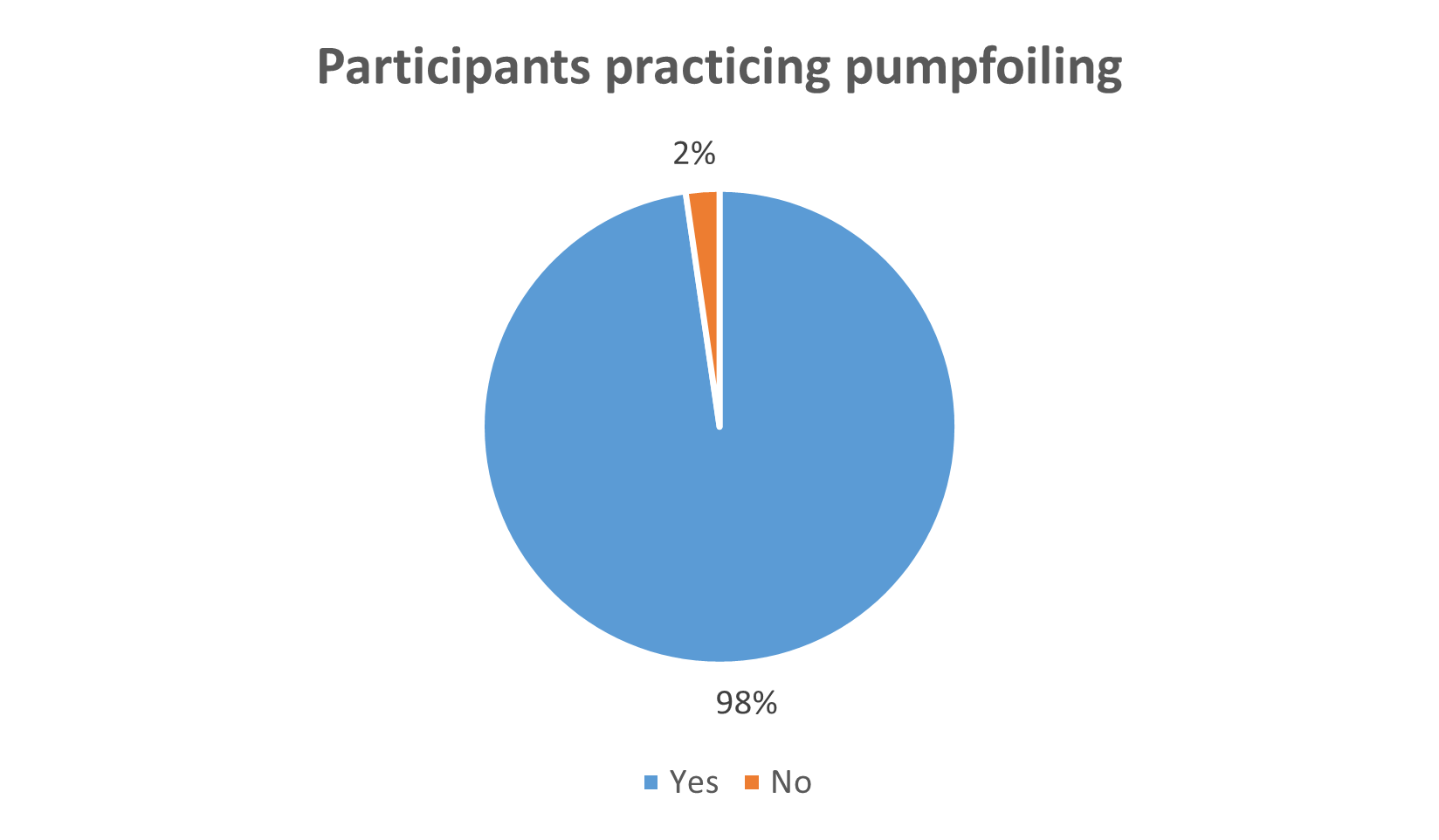
The survey was open to all, including both individuals who practice pumpfoiling and those who do not. 98% of the survey participants mentioned that they are practicing pumpfoiling. Overall, 131 persons participated in the survey.
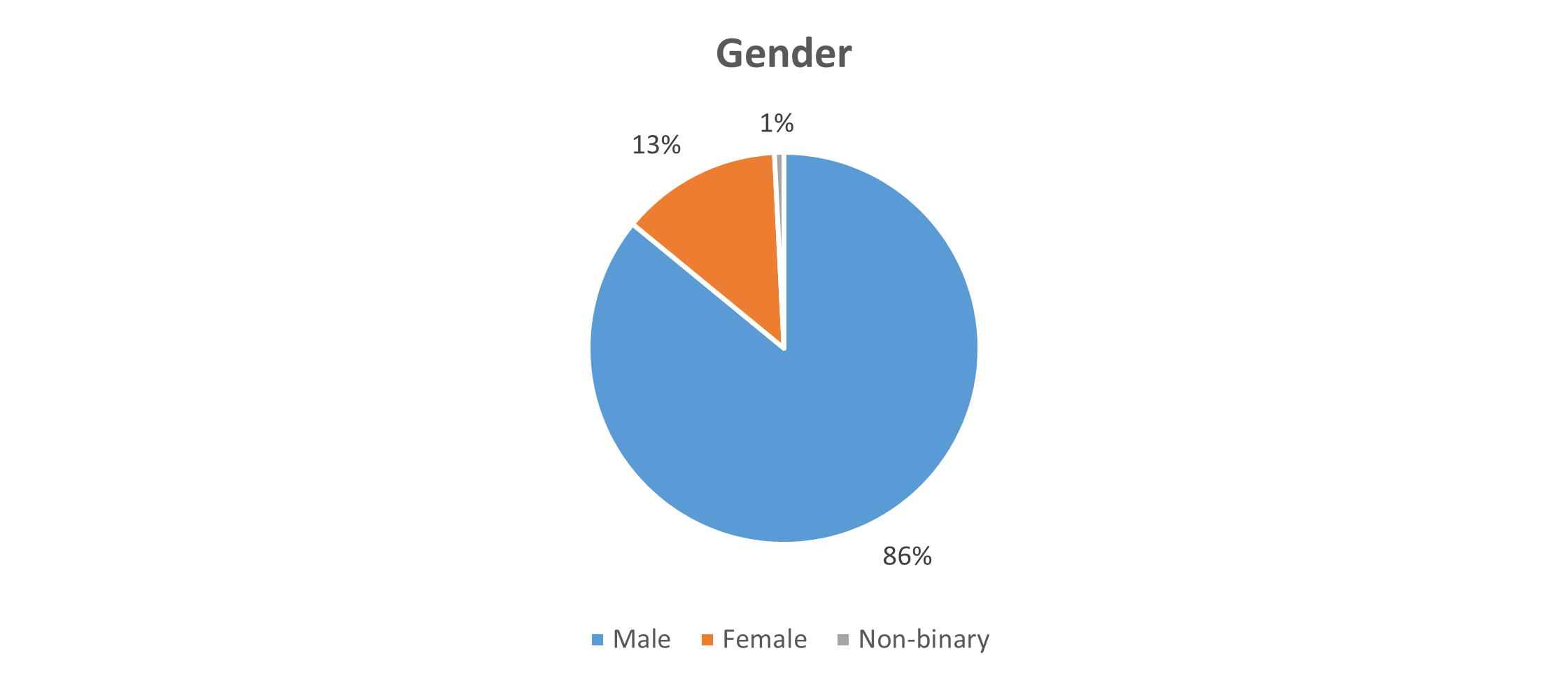
That pumpfoiling is a sport for everyone shows the distribution by gender and age of our survey participants. 13% of the participants were females, 86% males and 1% gender neutral participants.
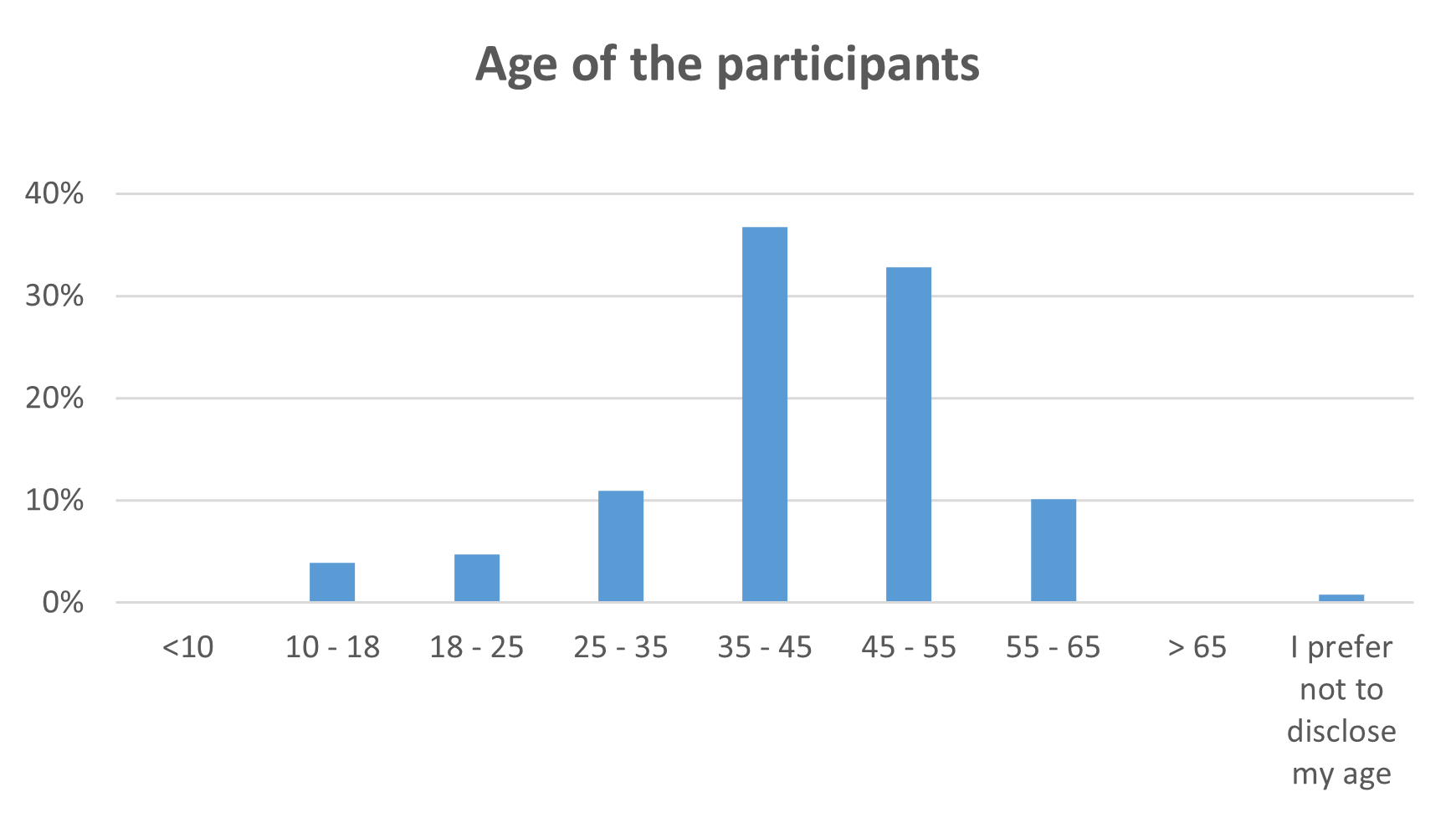
Looking at the age distribution of survey participants, we received feedback from individuals spanning a wide range—from 10 to 65 years old. This clearly demonstrates that pumpfoiling is a sport accessible to all generations. Anyone curious about trying pumpfoiling should feel encouraged to give it a go – it is never too late to start with pumpfoiling!
As mentioned in the introduction, people from 19 different countries responded to our survey. Most of the feedback (55%) came from participants in Switzerland, followed by 10% from the United States and 9% from Canada. Since the survey was launched in Switzerland and the requests for participation were published in various Facebook groups as well as local community groups there, it is not surprising that the majority of responses came from Switzerland. On the other hand, Switzerland is indeed home to a large and active community of pumpfoil enthusiasts.
Pumfpoiling – a growing sport
We dare to state that pumpfoiling is not anymore a completely new sport. Pumpfoilers are now seen in many places, and the sport continues to attract more and more passionate riders. The growing interest is also reflected in the industry, with an increasing number of brands entering the pumpfoiling market and launching new products. Beyond that, competitions and races are being organized across different countries, and a pumpfoiling world tour is beginning to take shape.
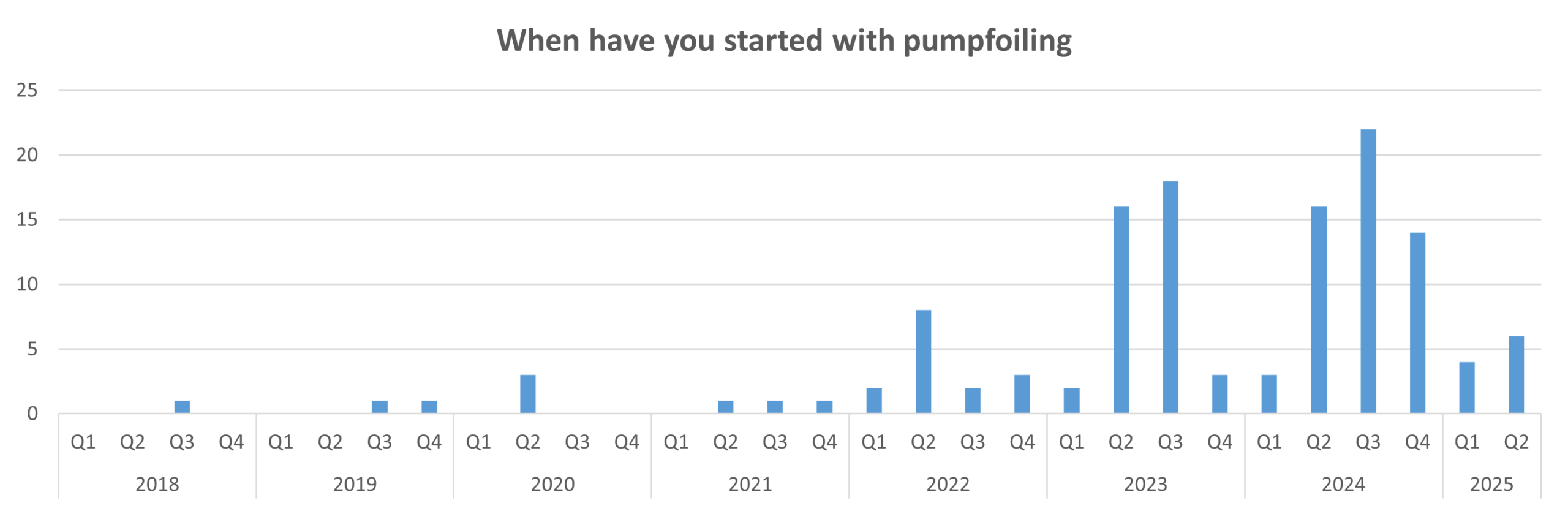
To put the answers from our survey participants into perspective, we asked them when they began pumpfoiling. From their responses, we can see that many participants started more than two years ago.
How did you first time get in contact with pumpfoiling
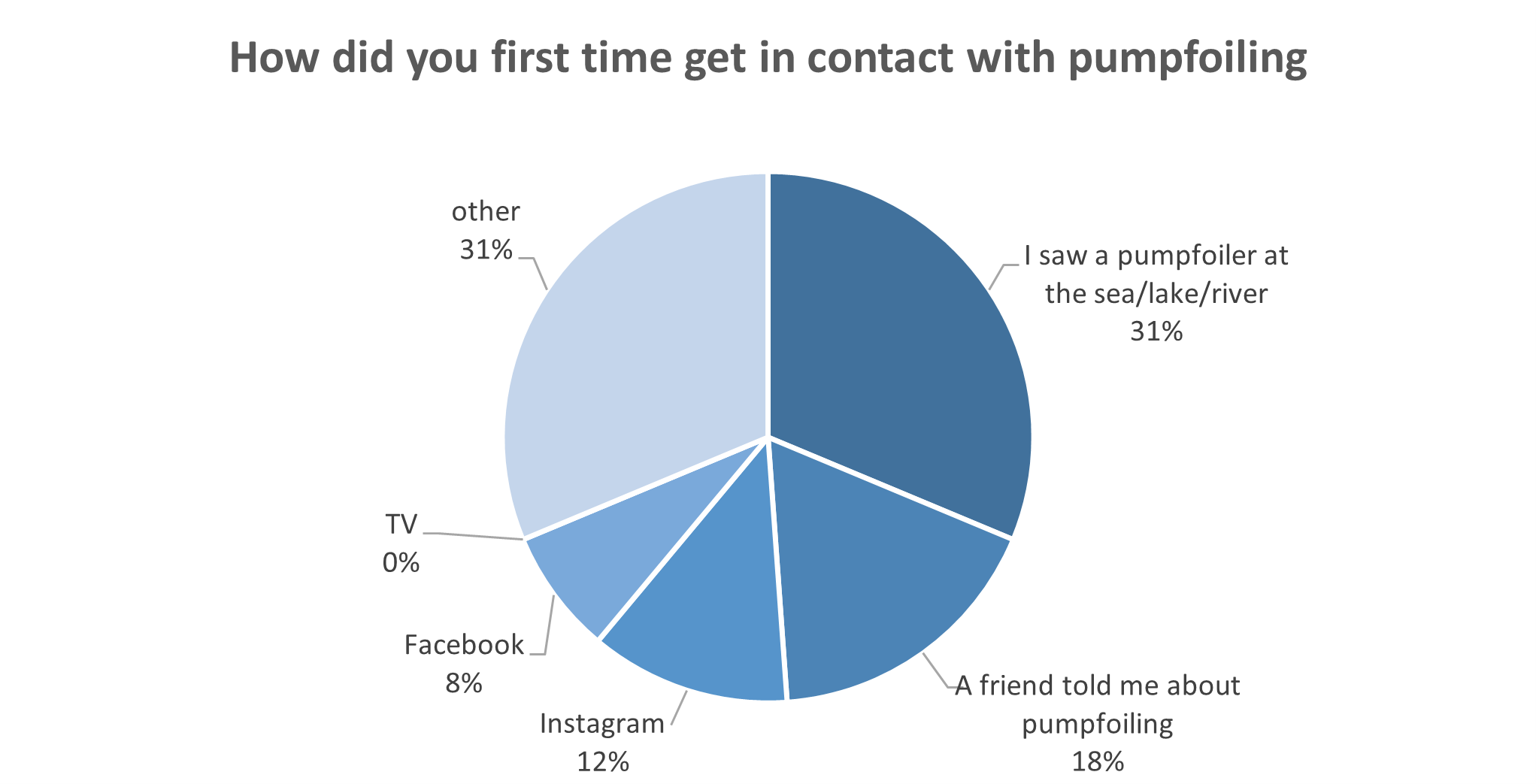
Talking about that pumpfoiling is a growing sport, we were also curious to hear from the survey participants how they get in contact with pumpfoiling. Most responses mentioned that they spotted a pumpfoiler and with that get in contact with pumpfoiling. However, the same amount of participants stated ‘other’ as a response, where the real touch point unfortunately remains a secret.
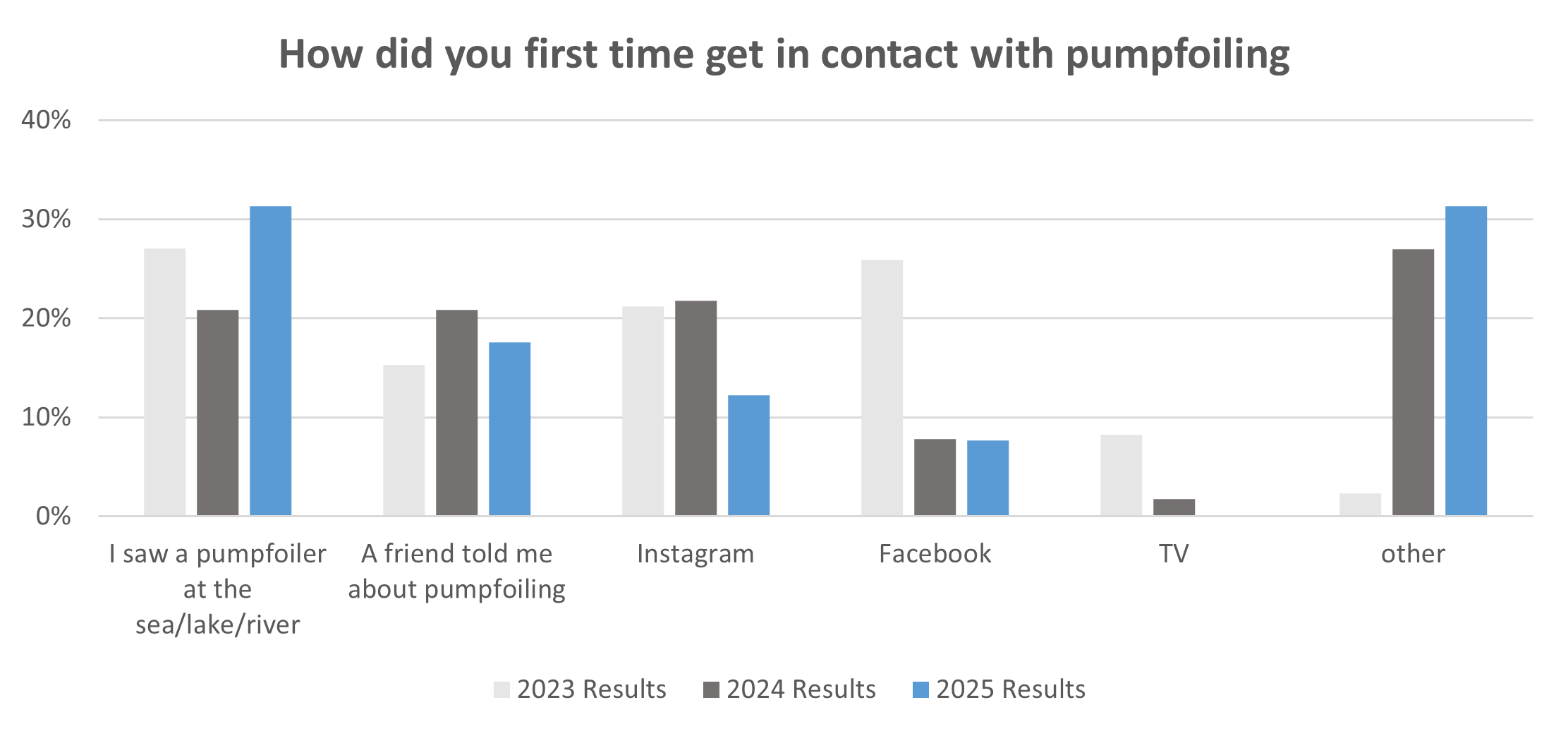
Comparing the 2025 responses with those from previous years, we can see that the channels through which participants first encountered pumpfoiling have remained relatively consistent. However, there is a slight trend suggesting that more people are discovering the sport by spotting a pumpfoiler in action. This aligns with the fact that pumpfoiling is being practiced by a growing number of individuals, which naturally increases the likelihood of seeing someone pumpfoiling at a lake, sea, or river.
Watching a pumpfoiler gliding almost silently across the water is truly impressive. There are many reasons why people feel inspired to take up pumpfoiling, and the community itself is made up of diverse types of riders. In our survey, we asked the participants what motivates them and what they strive for in the sport (the question offered a range of possible answers, with the option to select multiple choices).
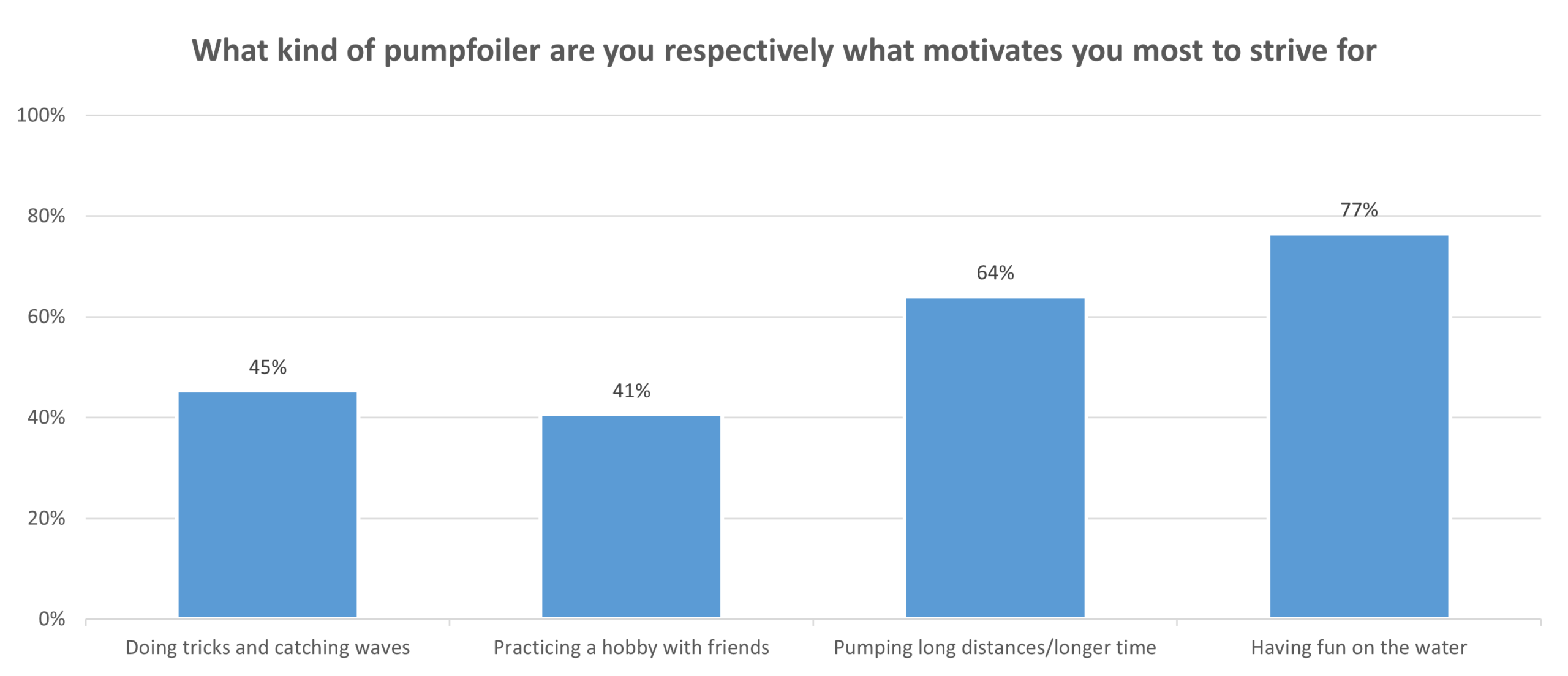
77% mentioned that having fun on the water is an important element for them. But also pumping long distances seem to be a motivational element which was mentioend by 64%.
How difficult is pumpfoiling?
The question that most probably every pumpfoiler has been asked already more than once is “how difficult is pumpfoiling?”. Pumpfoiling is certainly not a sport that can be mastered in just 30 minutes – it requires persistence and dedication to learn. Let us first have a look how our survey participants rate their pumpfoiling skills. As there is no clear definition about when you can manage pumpfoiling, we asked them to judge their skills level based on the following definition:
Beginner – I can land on the board but do not yet master more than 3 pumps
Intermediate – I can manage the dockstart and do more than 10 pumps
Advanced intermediate – I can manage the dockstart, pump for more than 20 seconds and manage front- and back side turns
Advanced – I can pump stable for more than 45 seconds
„Wakethief“ – I can pump for more than 60 seconds
Power Pumper – I can pump for more than 2 minutes
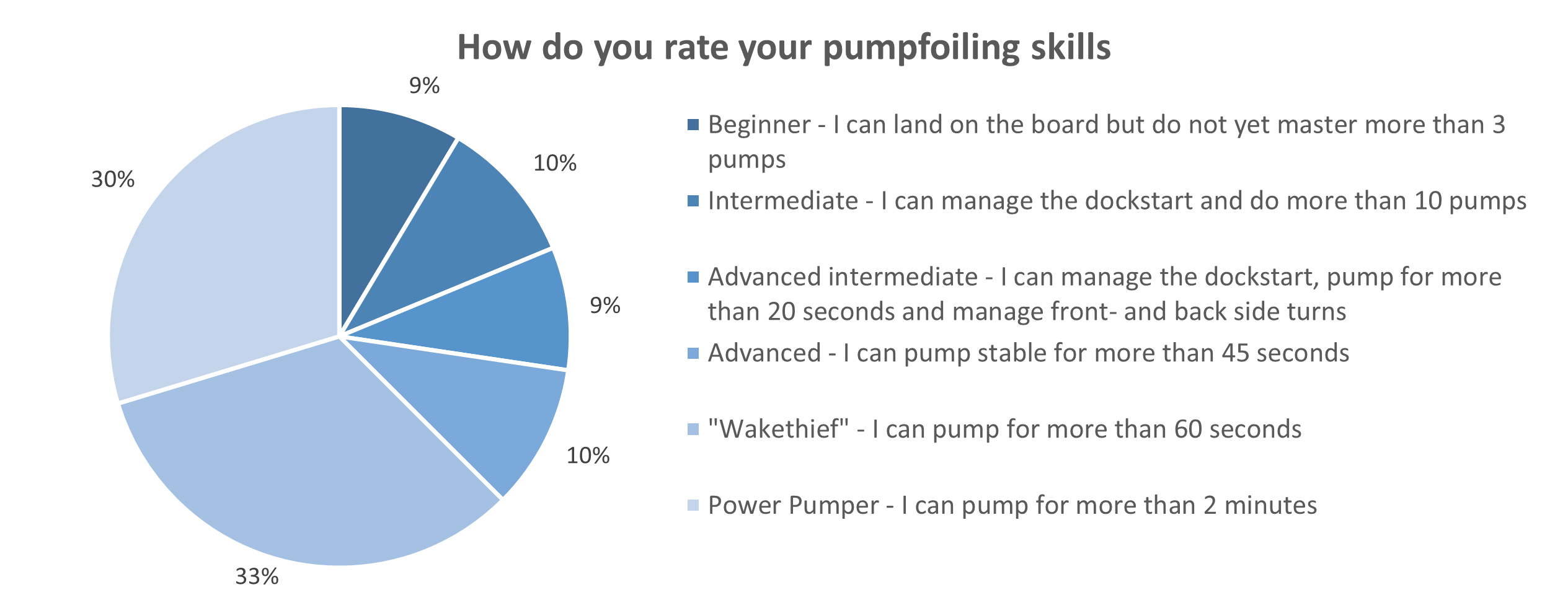
66% of the survey participants mentioned that they can pump for more than one minute, means they rate themselves as “Wakethief” or “Power Pumper”. 9% mentioned that they cannot yet master more than 3 pumps.
We were also curious to find out how long it took them to learn pumpfoiling, means to manage the start and pump for approximately 30 seconds. The following graph represents the answers from the current survey.
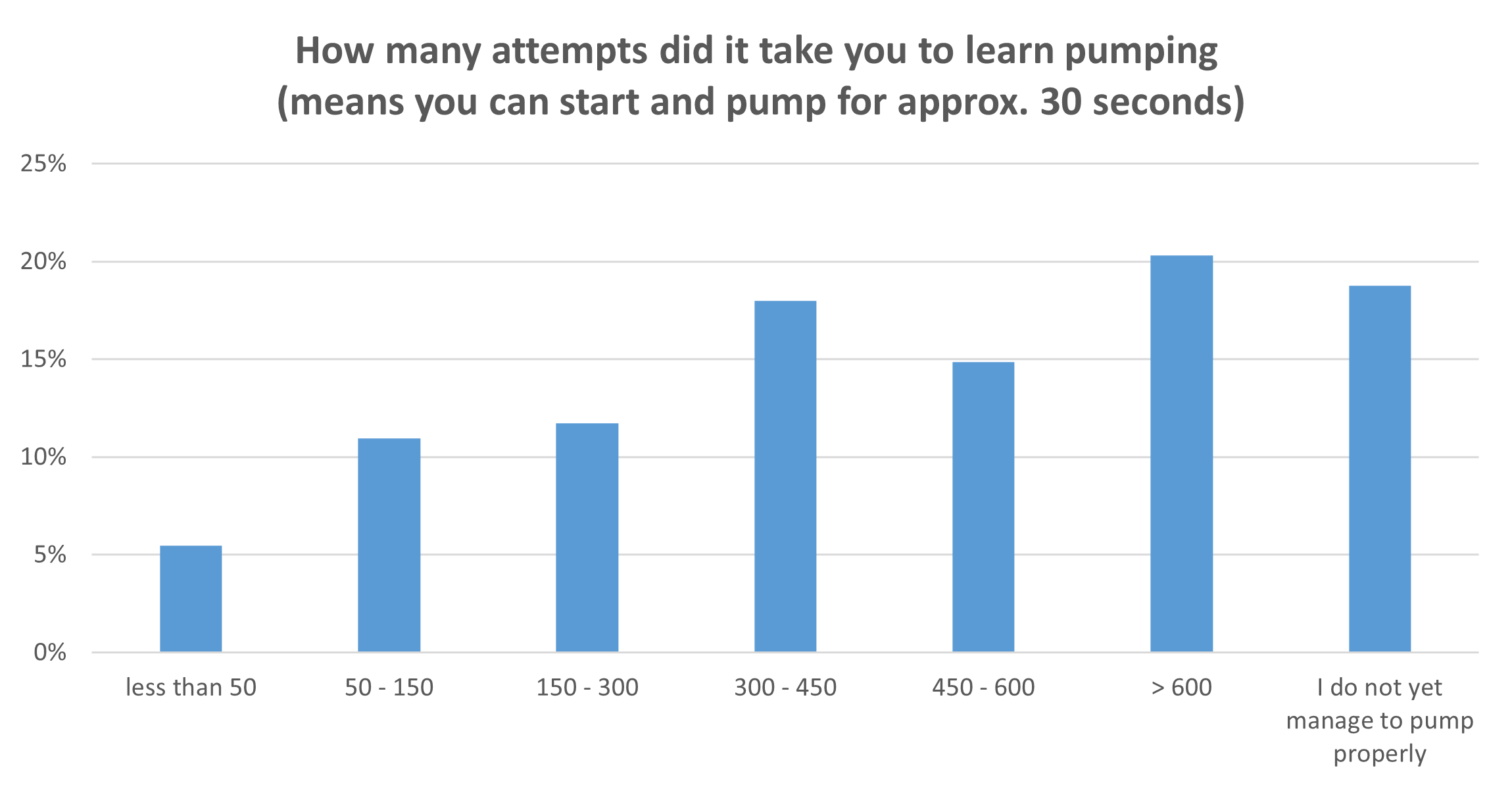
Applying the weighted average over the different categories of number of starts and count with the average number of the category (exceptions category > 600, there we calculated with 600 starts) we can calculate an average of 388 attempts until you can manage 30 seconds pumpfoiling. It becomes interesting when comparing this result with the last years survey results.
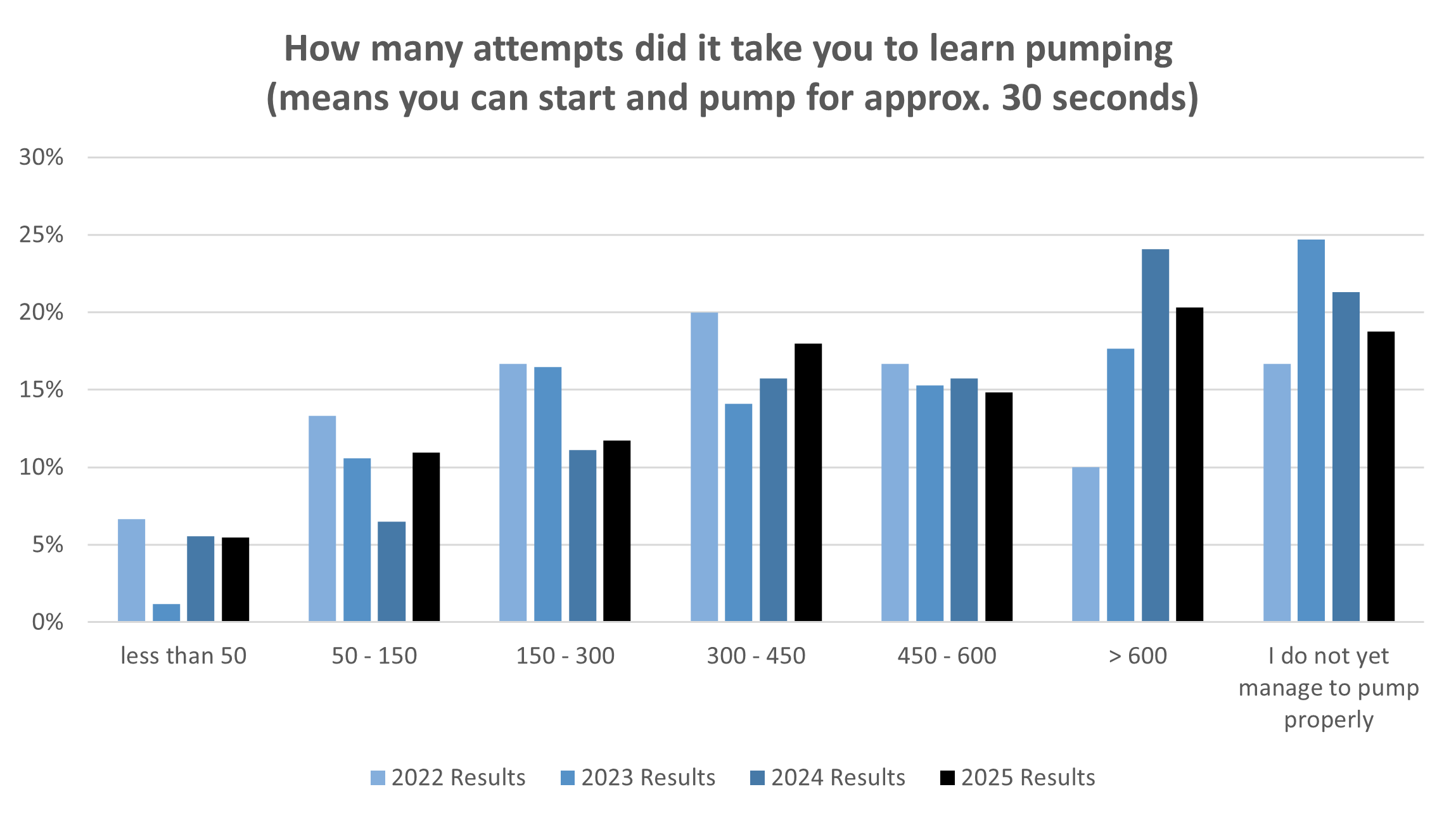
Taking the weighted average and counting therein the number of attempts the participants mentioned that it took them more than 600 attempts with 600 attempts, we can see that in the 2022 survey, the average number of attempts was 330 attempts, in the 2023 survey 381 attempts, in the 2024 survey 405 attempts and in this year’s survey now 376 attempts.
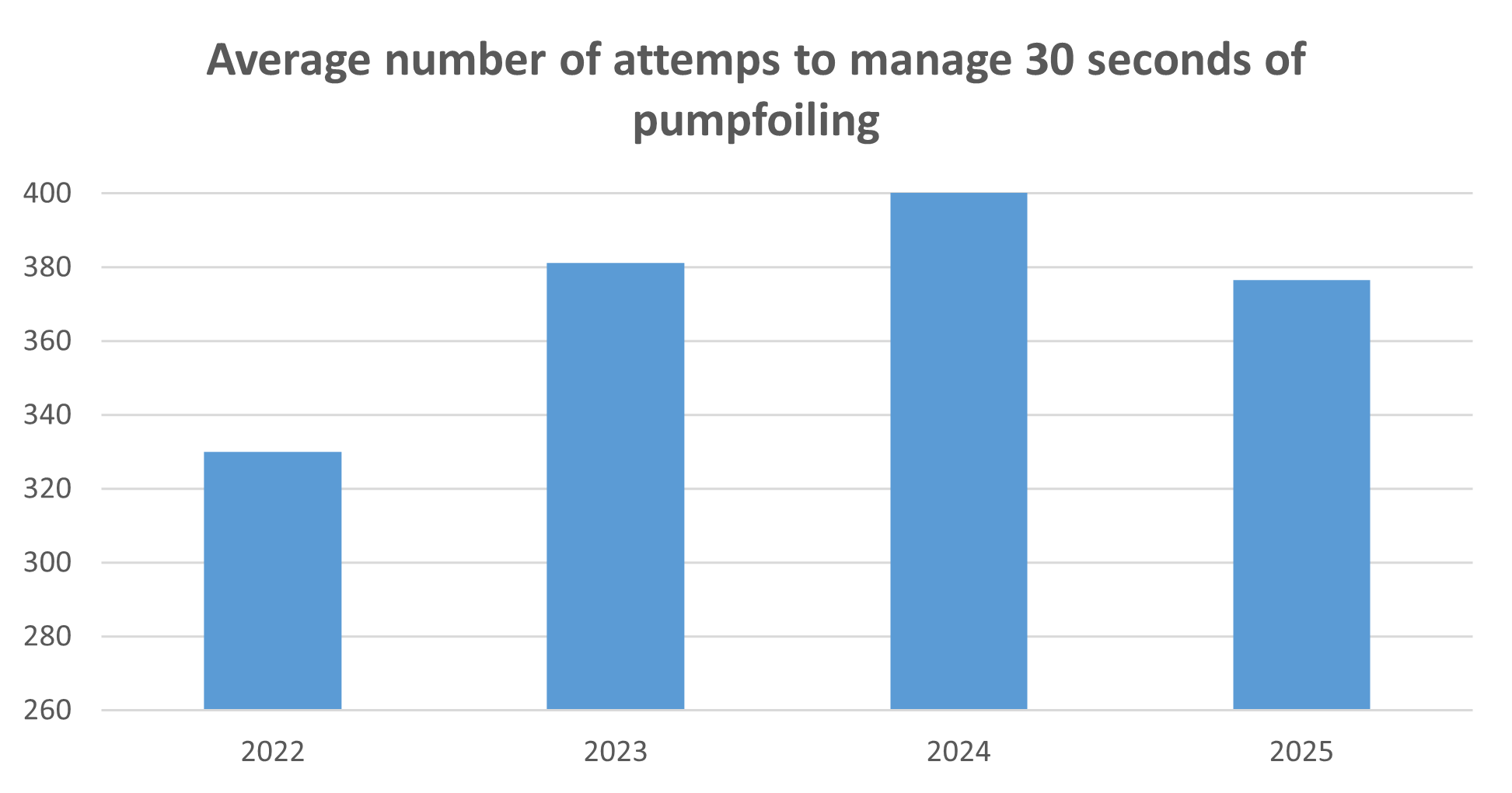
Since 2022 we have seen a increase on the average number of starts it takes to learn pumpfoiling. Due to the limited number of samples as well as the challenge that most probably most of the pumpfoilers do not do a perfect log on how many attempts it took them learn pumpfoiling, it is difficult to derive a well underlined conclusion. As discussed in last years survey, a potential reason could be that pumpfoiling has over the last years developed more into a grassroots sport and the ones who did their first attempts already two or three years ago, had already experience with other foiling sports. On the other side, the pumpfoil gear and especially the foils made a tremendous developed, which should also lead to have better equipment for beginners and with that, the number of attempts should actually come down.
We are honest, that would be a nice story to explain the data here in the survey 😉 However, well knowing the number of participants, it would be a very bold statement to say that this explanation is found again in the data. Hence, do not let us speculate more about it and let us see what the future will bring.
Besides asking the participants about their number of attempts, we also asked them in terms of time how long it took them learn pumpfoiling. Obviously, this will depend on the number of attempts you do per session as well as on how often you practice pumpfoiling.
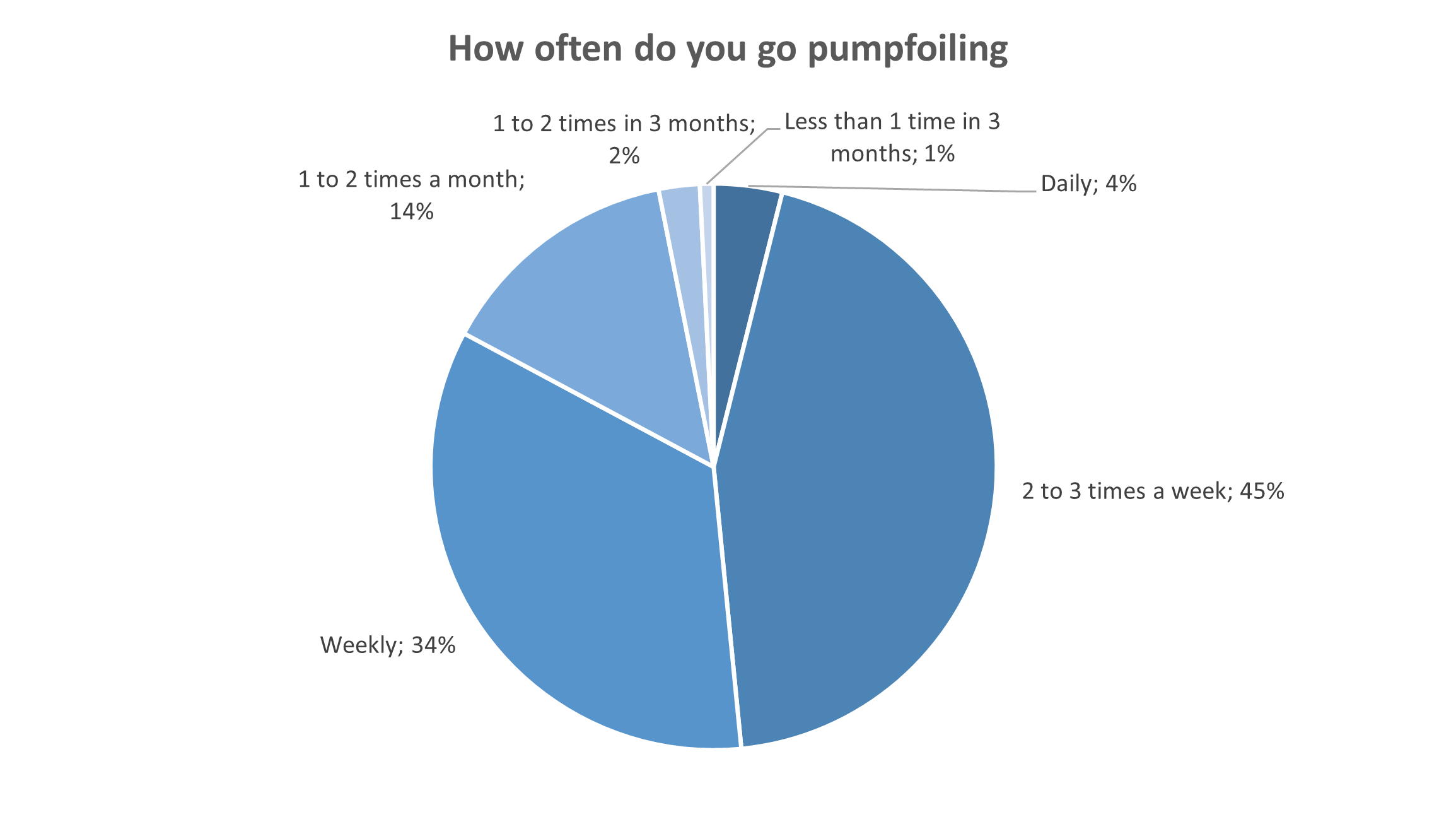
83% of our pumpfoiling survey participants mentioned that they go at least once a week for a pumpfoiling session. Only very few mentioned, that they can practice pumpfoiling less than once a month.
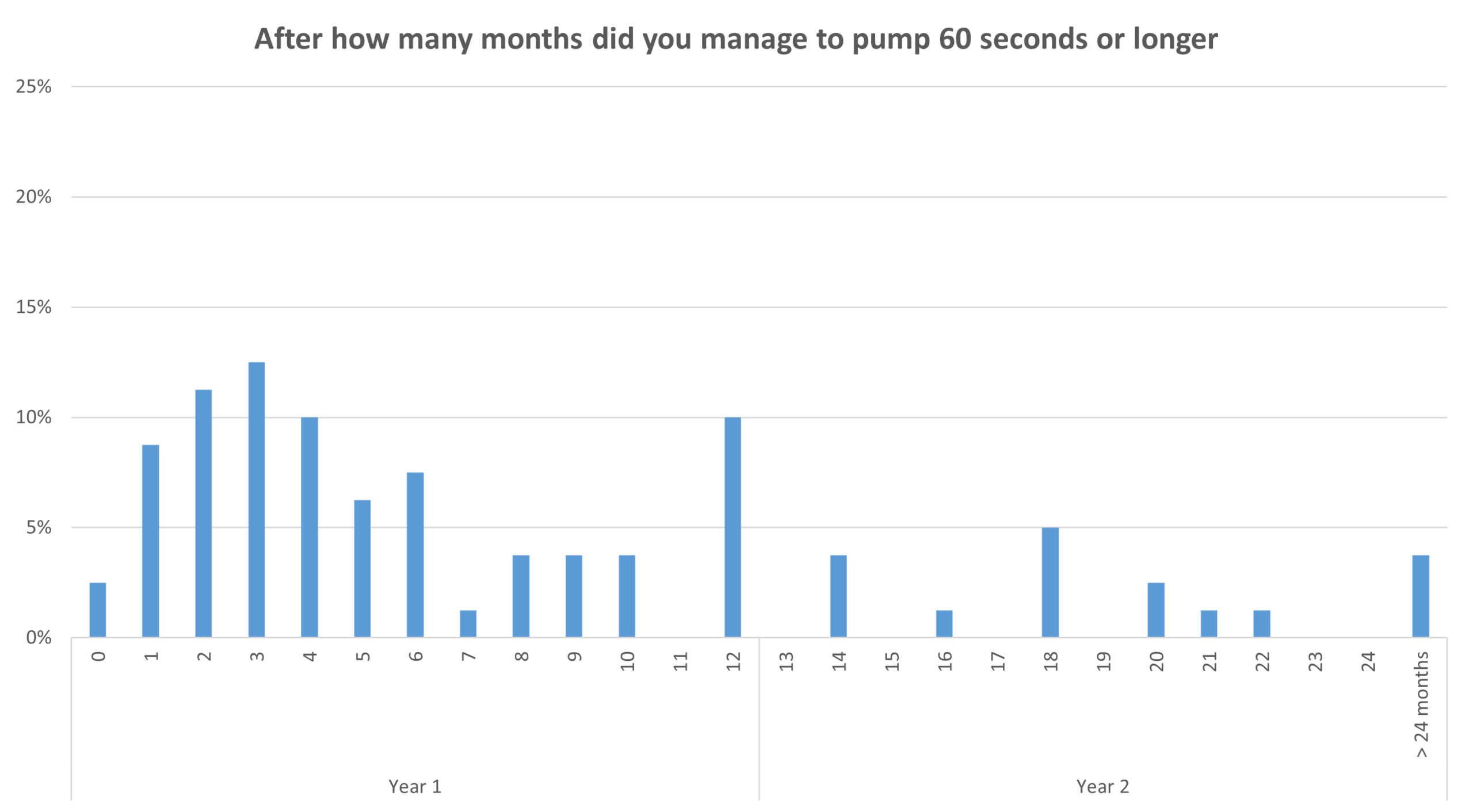
Coming back to the question how difficult it is to learn pumpfoiling and how much time it takes to learn pumpfoiling, we asked in the survey also how long it took them to become a „Wakethief“ – means that they can manage to pump for 60 seconds or longer – in terms of months.
What is the preferred take-off method of the survey participants?
A foil only generates lift, when there is a relativ velocity to the surrounding medium of it (see also article „Physics of a hydrofoil“). That means, we need a take off method with that the foil either already has some initial speed when we are landing on it or that immediately generates speed once we get in contact with the board. The variety of starting techniques is manifold.
Whereas some are standing still, give a gentle push to the board and then jump directly from standing onto the board, some others run a few steps and then jump onto the board. Another method you can observe is what we call the „drop start‘. Thereby, you drop the foil into the water and then jump on the board. That technique you can often observe when pumpfoilers are using higher docks, where it is difficult to submerge the foils in the water while standing on the dock. Last but not least, also some use dockstart devices, means using a fixation that holds the board and you then run and jump on the board.

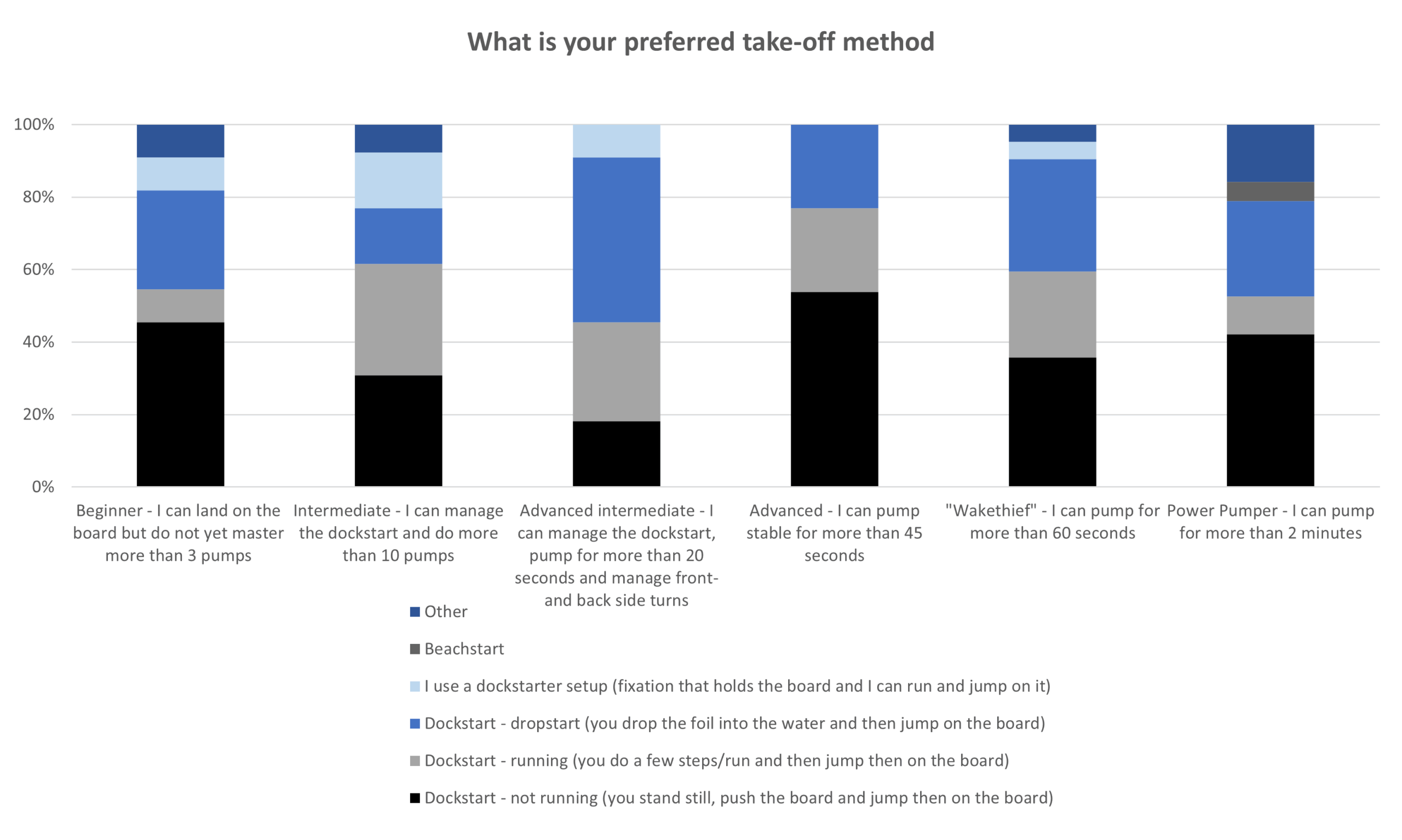
The participants in our survey seem to favour the dockstart without a running start. 38% of the survey participants mentioned, that the „dockstart – not running“ is the preferred take off method for them.
Obviously, the take off method also depends on the available dock/take off location. That may also one of the reasons, why most of the different take off techniques, apart from the beach start, are mentioned by all foiling levels.
One aspect not captured in the survey is whether participants’ preferred starting techniques have changed over time. As a result, we cannot draw a definitive conclusion about which technique may be easier to learn. However, if we assume that participants have remained consistent in their chosen starting method, we can analyze the data to explore whether one technique leads to faster learning progress.
To begin, let us examine the distribution of responses to the question: “How many attempts did it take you to learn pumping (defined as being able to start and pump for approximately 30 seconds)?” broken down by starting technique.
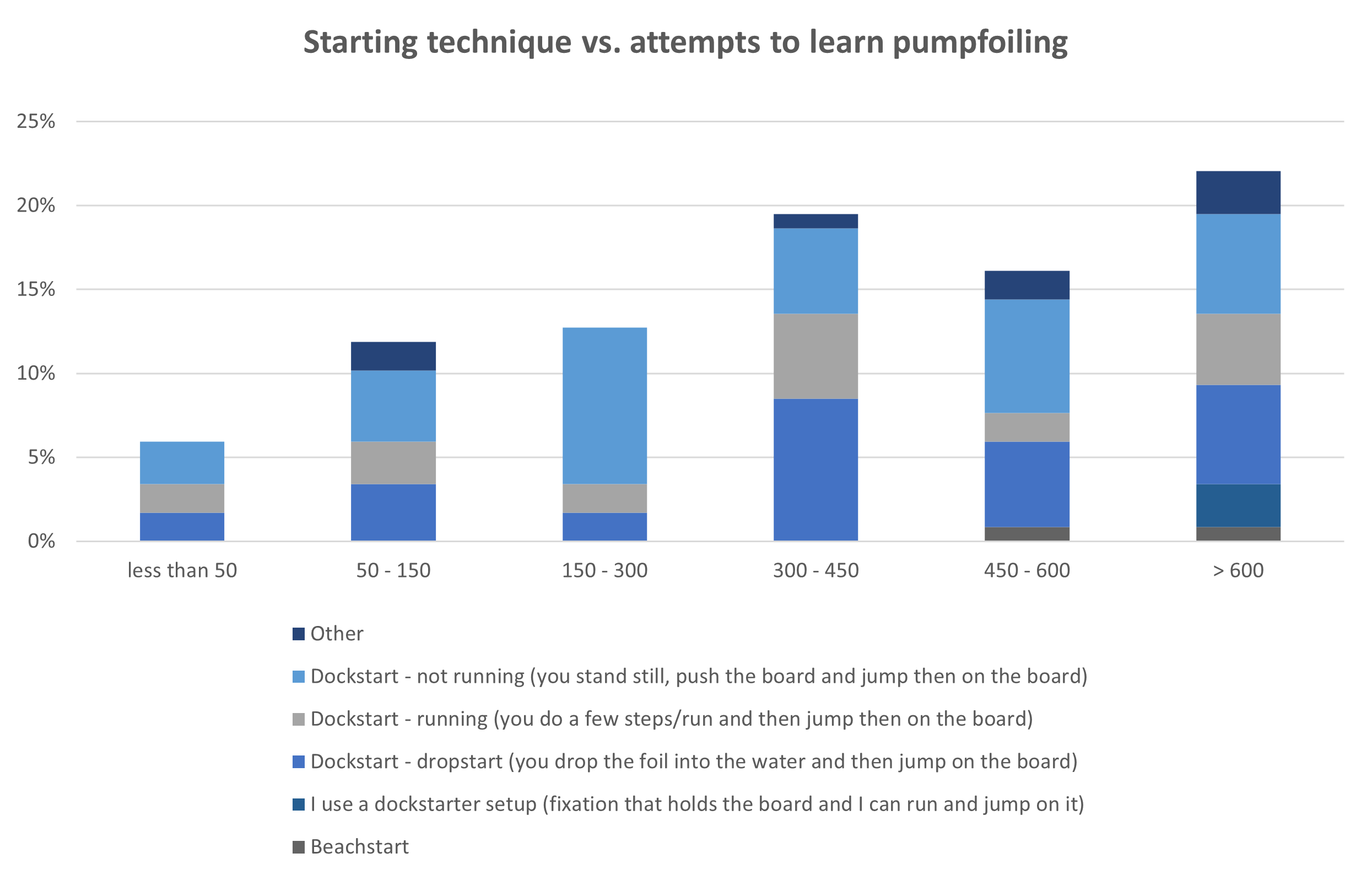
Focusing only on the responses from participants who have already mastered pumpfoiling, 7% reported that it took them fewer than 50 attempts. These individuals used techniques such as dockstart – not running, dockstart – running, and dockstart – dropstart. Looking at the distribution in the graph, it appears that the dropstart – not running method shows up more frequently in the categories with lower numbers of attempts, suggesting it may be slightly associated with faster progress.
Calculating the average number of starts (please note, that for the group with the answer „>600 attempts“ we calculated with an average of 600 attempts) we can conlude that the ones with preferred starting technique „dockstart – not running“ and „dokstart – running“ needed in average the least number of attempts to learn pumpfoiling.
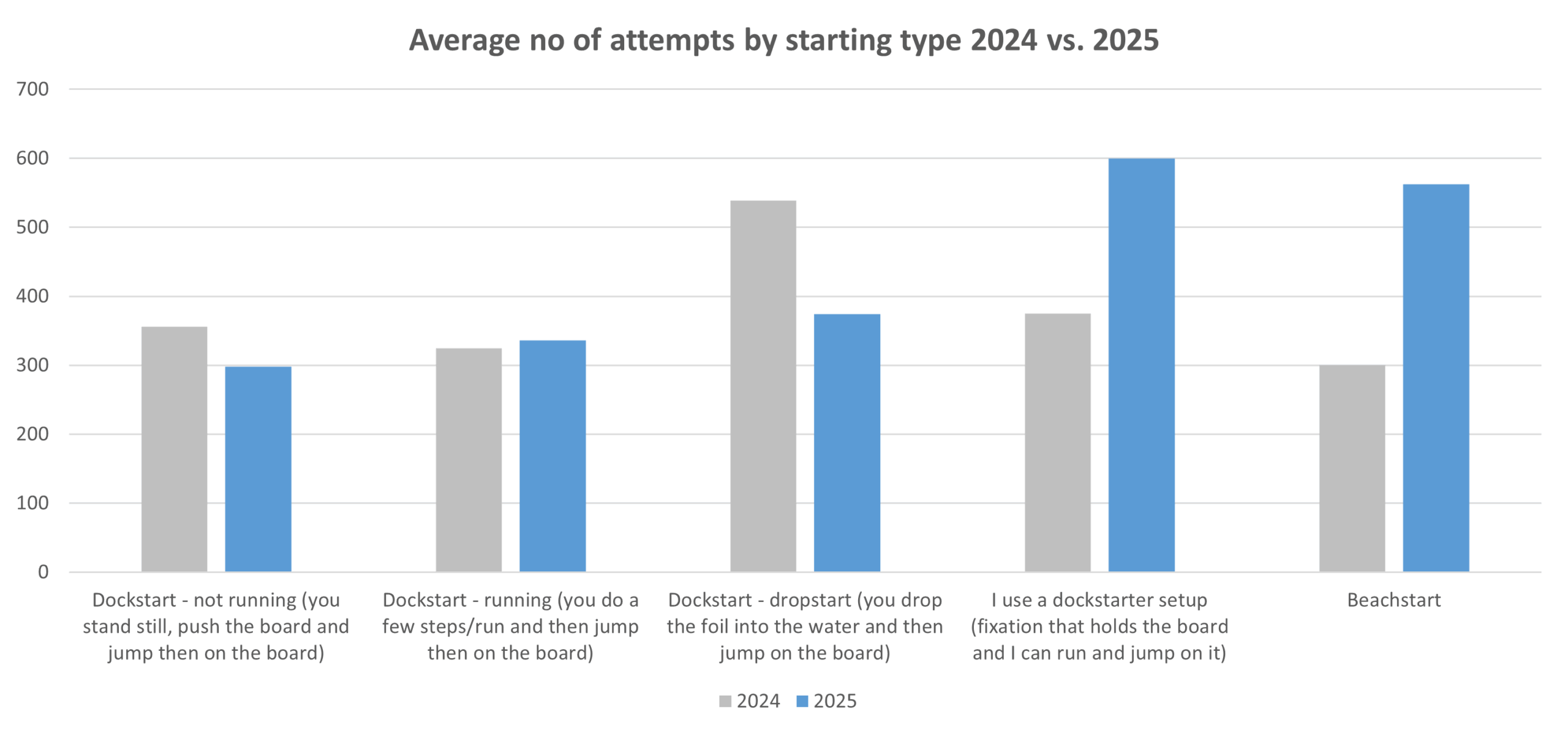
As only very few people mentioned that the beachstart is their preferred starting technique, we have to be a little bit careful with interpreting too much into the result of that group.
What is the longest pumpfoil run?
Most probably every pumpfoiler was confronted with the question „For how long can you pumpfoil?.
Well, the first hurdle you have to overcome is to successfully master the dockstart. But once you managed that, many pumpfoilers will work on the endurance and try to do longer and longer runs. With new equipment being developed, also new records are set. At the time of doing this survey, the record was 4hrs and 2min.
Looking at the participants in our survey, the average time of the longest run is 359 seconds (5 minutes and 59 seconds) compared to 259 seconds in the 2024 survey . The the median is 80 seconds (1 min and 20 seconds) whereas in 2024 it was 53 seconds.
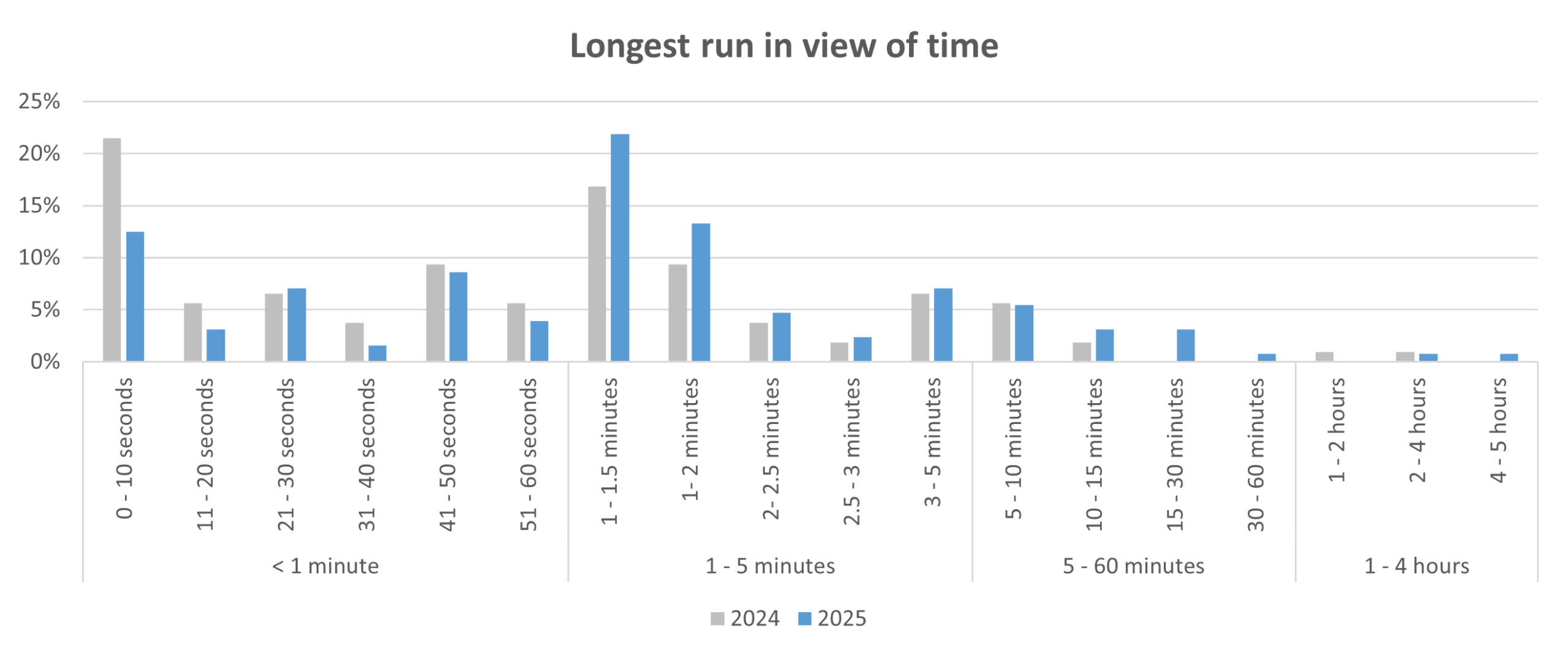
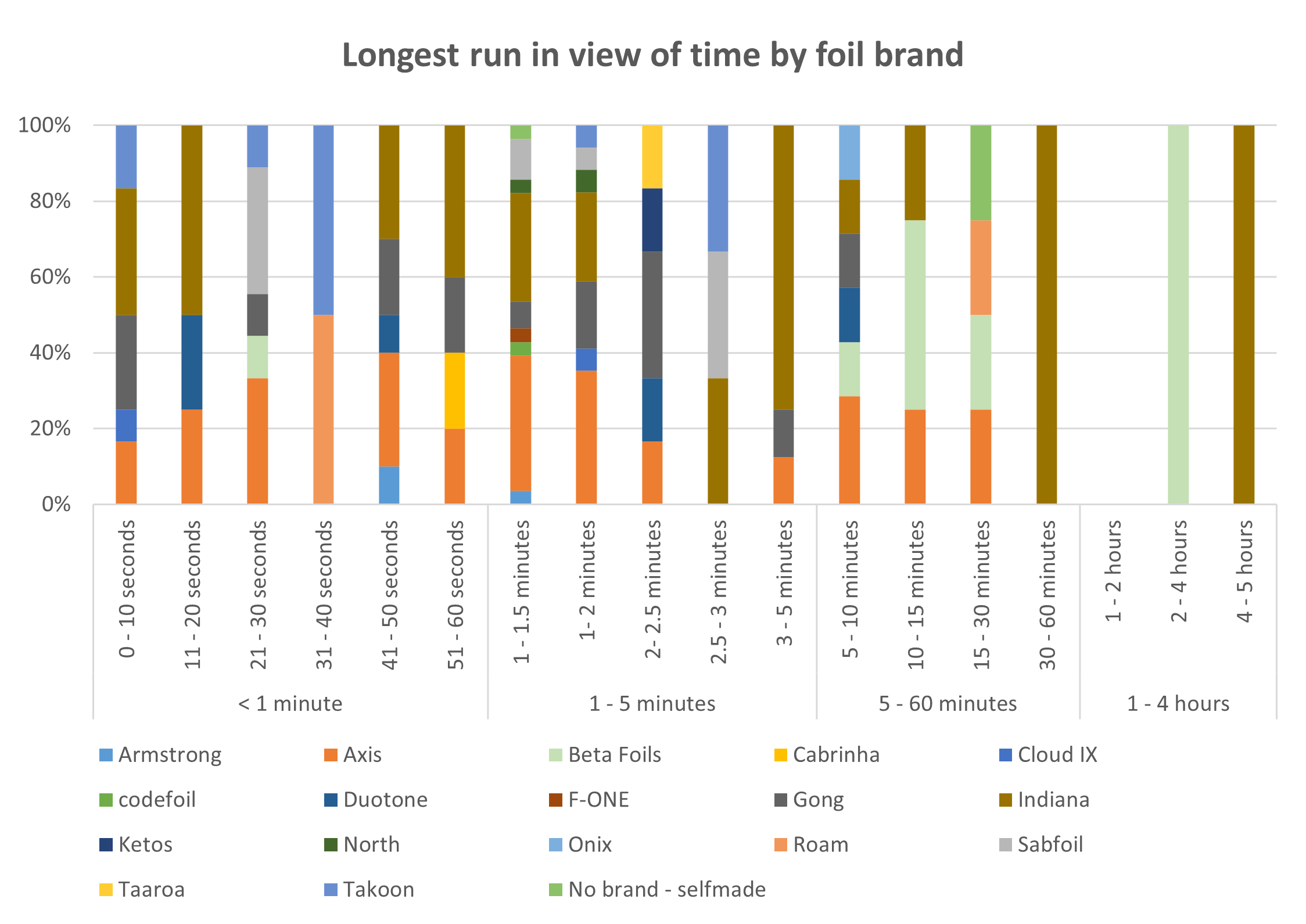
The duration someone can pump depends both on the rider’s skill level and the equipment used. Beginner foils generally provide more lift at lower speeds, but they also create greater drag, requiring the rider to expend more energy while foiling. Since many people ask which foil performs best for long pumpfoiling runs, we analyzed the relationship between foil brand and the longest runs achieved by our survey participants.
In the following graph, we compared responses to two key questions: “What brand is your most frequently used foil?” and “How many seconds was your personal longest pumpfoil run?” The results are plotted according to the distribution of time intervals, providing insights into how different brands align with performance outcomes.
Looking the top 5 results (five longest runs) submitted in the survey by our participants, we have the following results:
| Rank | Frontwing Brand | Frontwing Model | Longest Run |
| 1 | Indiana | Indiana Condor XL | 4hrs 2min |
| 2 | Beta Foils | Beta Freefoil | 2hrs 30min |
| 3 | Indiana | Indiana 1396P (*) | 1hr |
| 4 | Beta Foils | Beta Freefoil | 26min |
| 5 | Axis | Axis ArtPro 1401 | 21min |
(*) The successor model of the 1396P is the Manta XL . It exactly the same model just with a new name and graphics.
It is important to highlight here, that this is only a snapshot of the longest runs of our survey participants. As we do not collect names with the survey, we cannot be 100% sure, but it seems that the current world record holder participated also in our survey. At least as far as we could find out with our research, the current world record is at 4hrs 2min. The reference article can be found here: Nicolas Iten breaks the pumpfoil long distance record again
Equipment
While in most areas you can use the water and take off location free of charge, the equipment itself is not cheap. Acquiring a new pumpfoiling setup is quite an investment. However, as the sport becomes more and more popular, also the second hand market is well developing which allows to get good second hand material at a reasonable price. Although there are more and more shops and schools that also rent pumpfoil equipment, most of our survey participants have their own equipment.
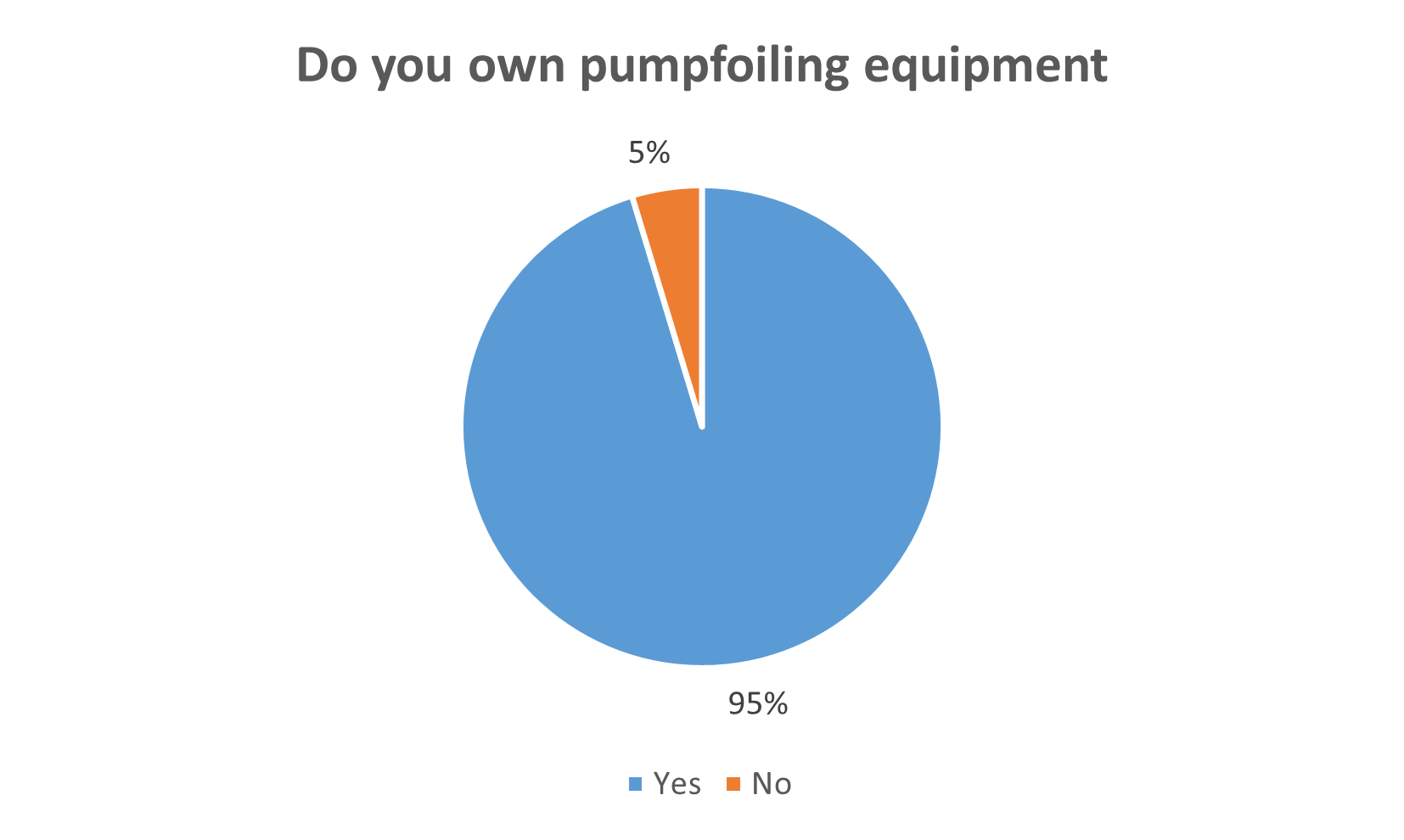
That the second hand market is developing is also represented by the answers from our survey participants. 37% mentioned that there first equipment they bought was a second hand equipment.
What about the equipment our participants are using? As noted in the introduction to this survey, the number of respondents is not evenly distributed across all global regions. This means that some results may be influenced by the geographical location of participants and the availability of equipment in their area.
To begin, let us take a closer look at the brand of foil most commonly used.
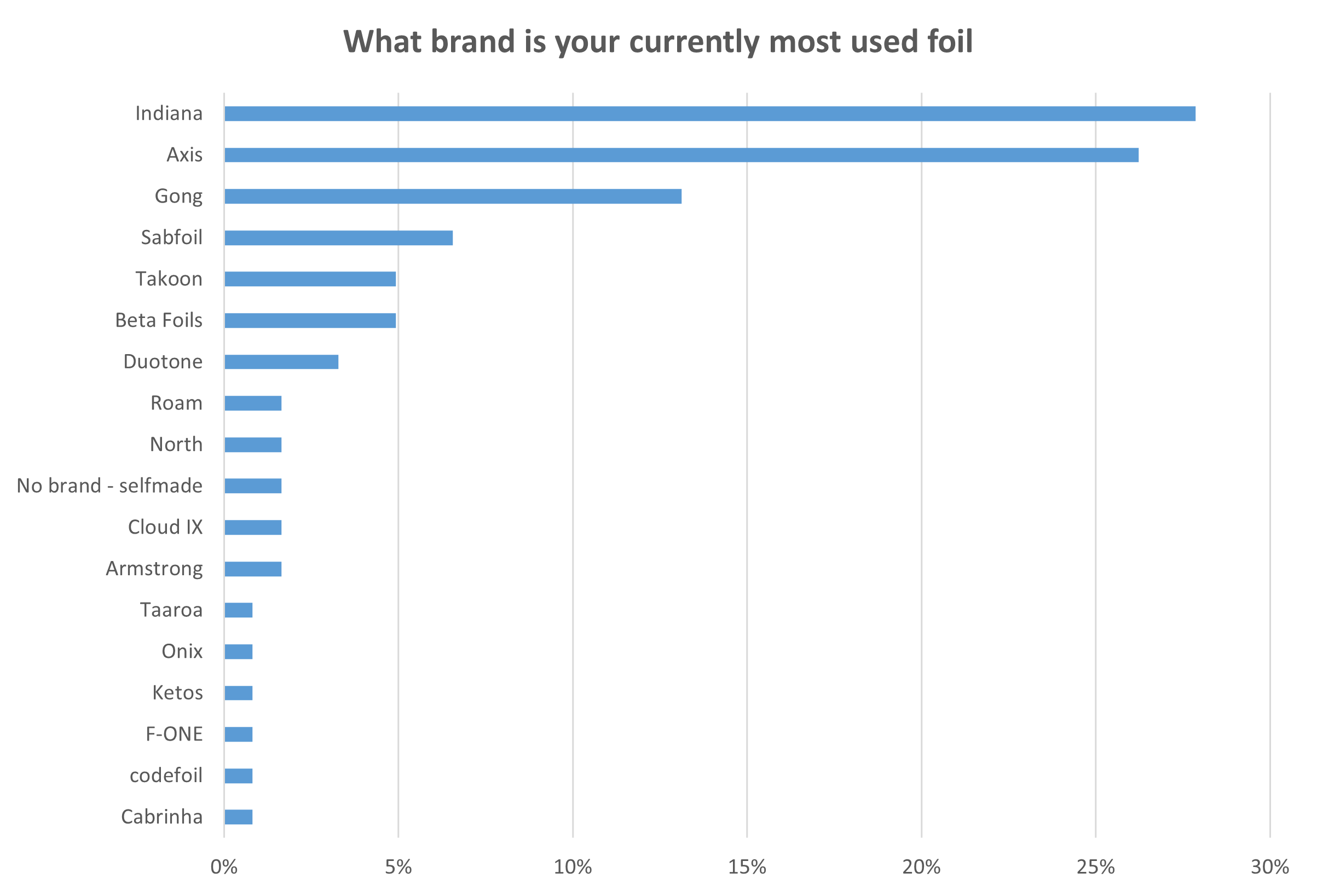
In most cases, it is not possible to combine individual foil components from different brands—for example, an Axis fuselage typically cannot be paired with a Sabfoil front wing.
However, there are also some brands starting to develop adapters so that you have some more flexibility. There are e.g. Lio-Tec adaptors that allow to exchange certain parts from Axis and Indiana.
With the combination board – foil it looks sligthly different. At least most brands have standarized sizes of the mast plate/screw patterns and board foil/mast tracks so that you can combine a board from one brand with a mast – and therewith also foil – from a different brand. Let us now examine whether this pattern can also be observed in the responses from our survey participants.
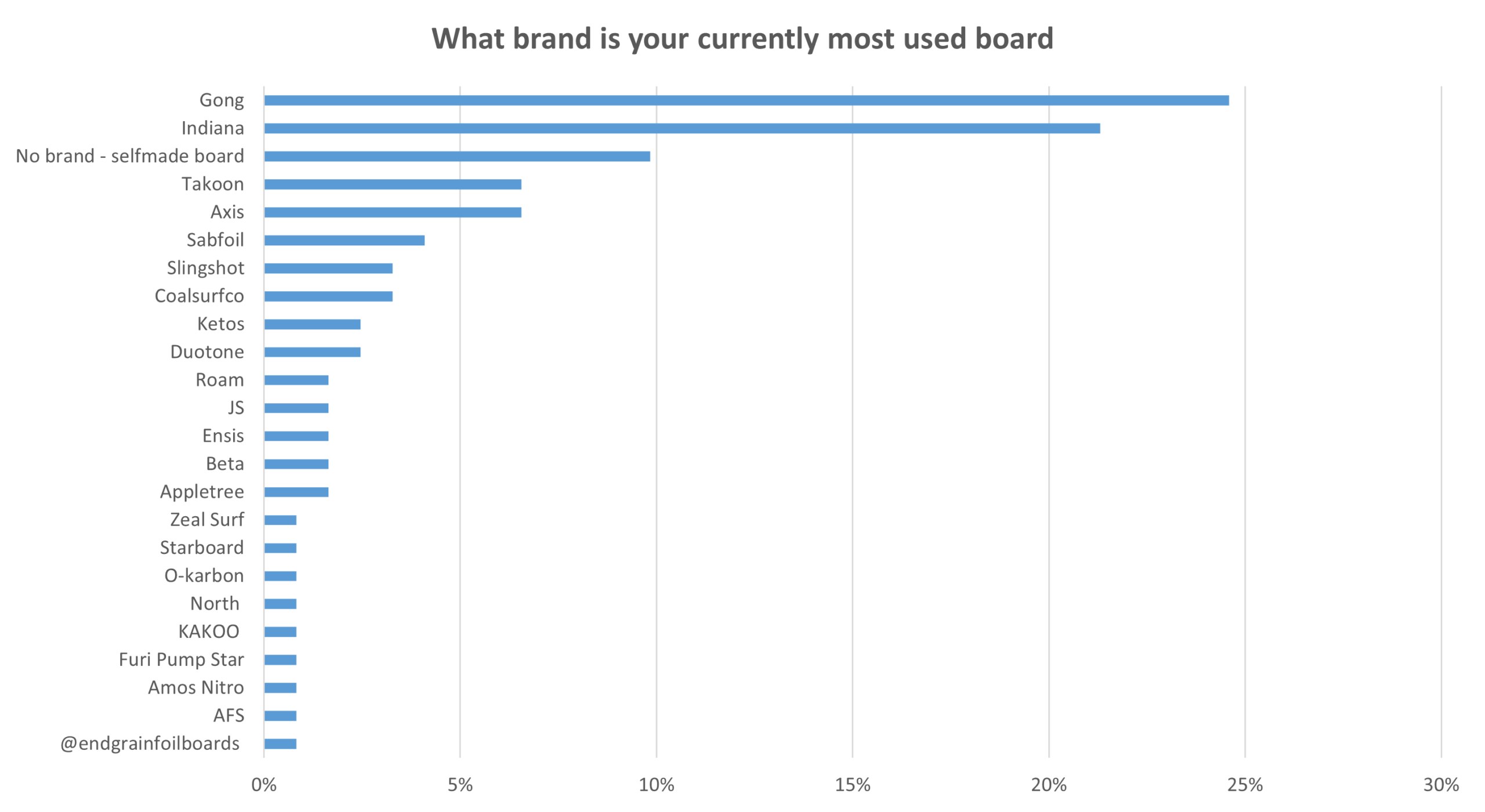
Comparing the brand of the foils with the brand of the board, we can observe, that there is a difference in the figures.
Looking into the details of the data, we can see that Gong boards are combined with foils of nine different brands as well as selfmade boards are combined with seven different foil brands. That may explained by the quite low prices for boards with that Gong came in the market with their Kluber series. Selfmade boards often are another option for cost effektiv solutions.
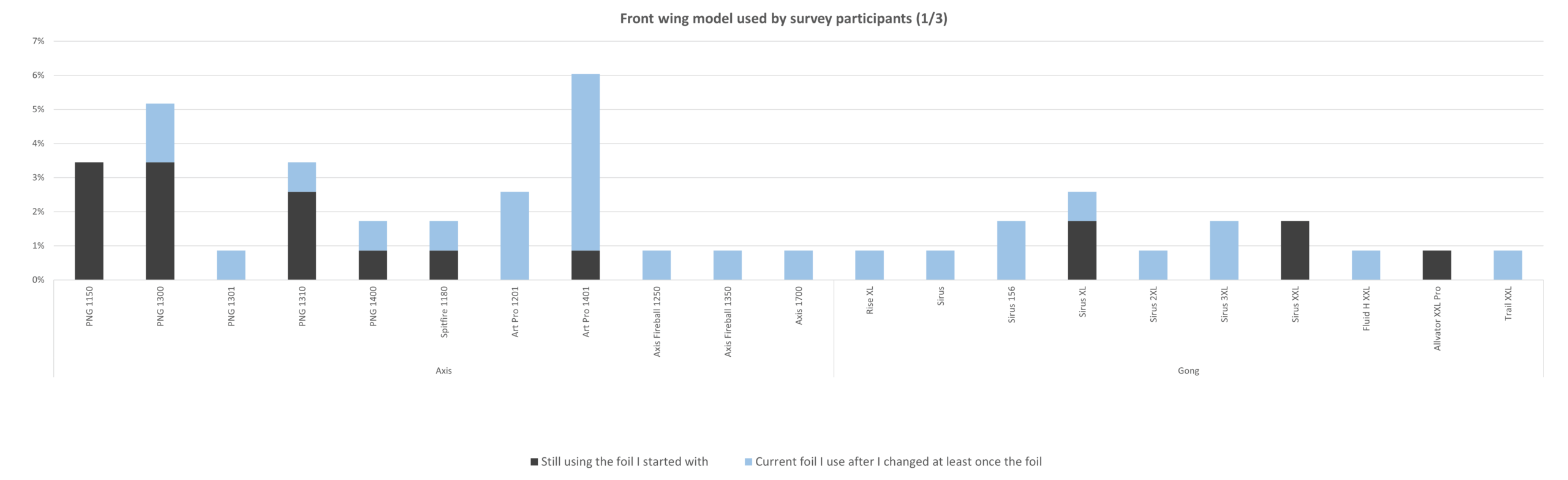
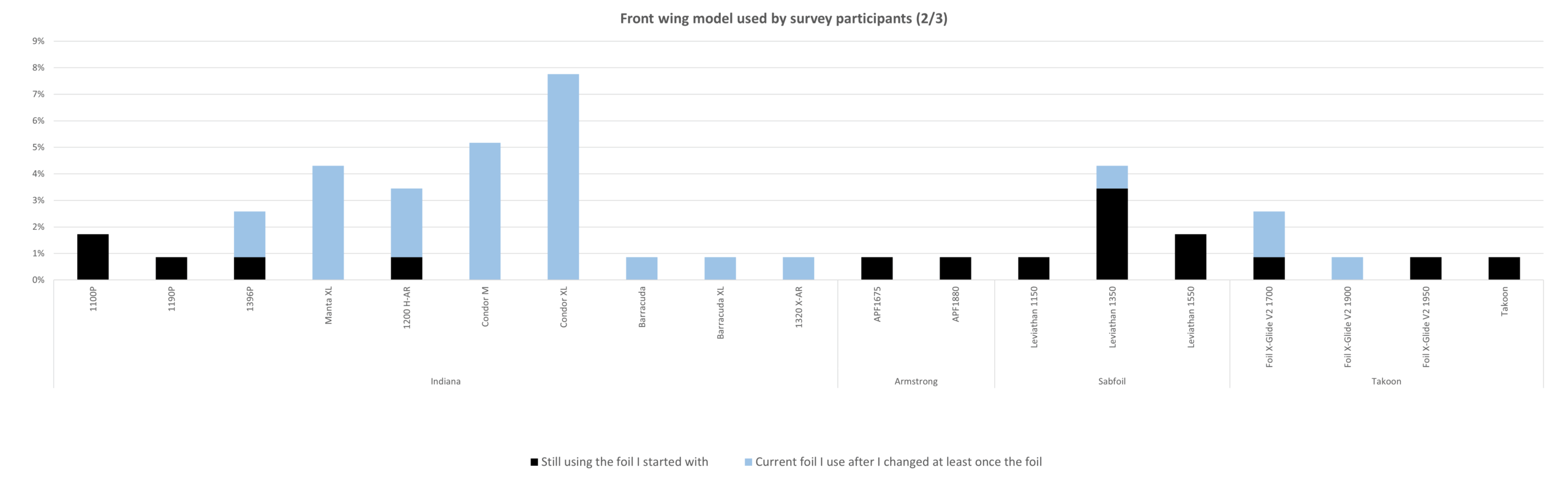
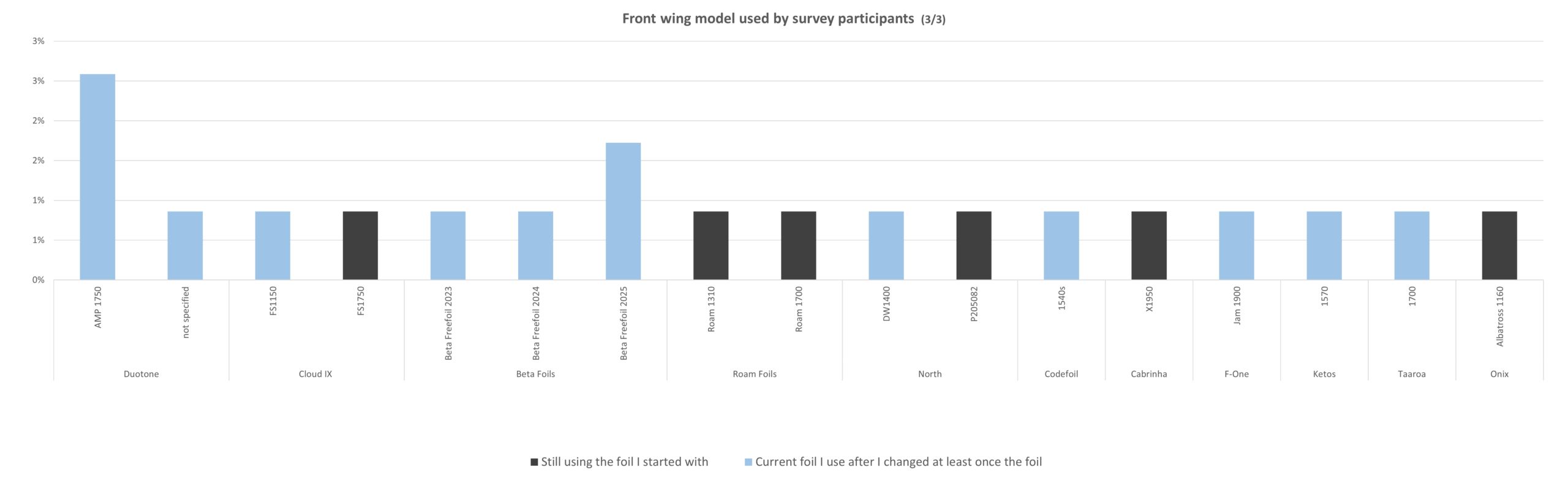
That there is a big variety of foils available in the market is also represented by the answers of our survey participants. 57 different frontwing models were mentioned by 116 participants (please note that we have exluded the self made foils as well as those answers that could not be verified/had a completely unclear description). Keeping in mind that a frontwing in most cases can be combined with different fuseslages and stabilizers, we will most probably only find very few setups, that are identical.
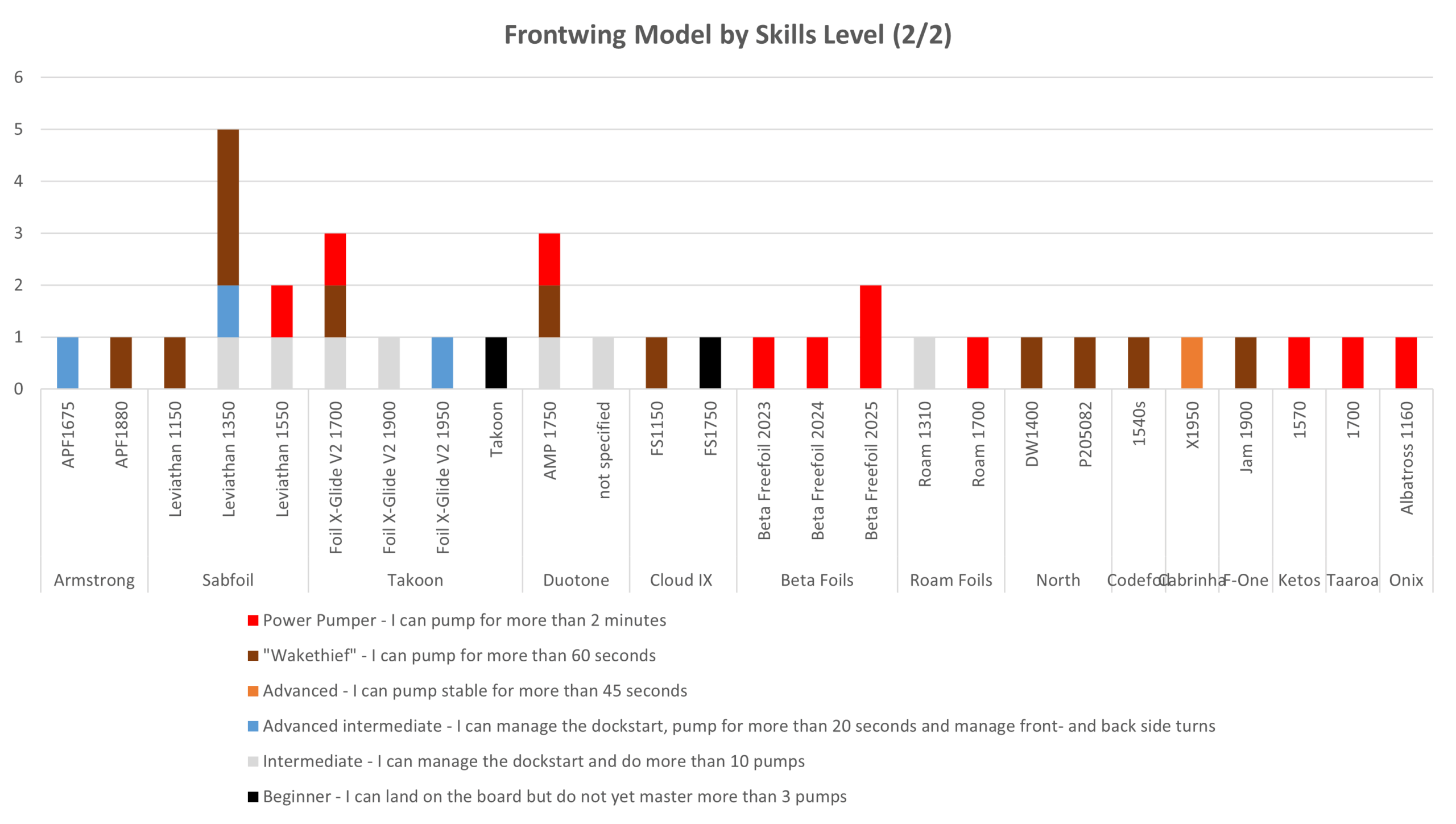
In the following charts we show you which frontwings are used by our participants and if the model is the initial model they started with, or if it is already a foil that the foiler has changed to after starting with pumpfoiling.
Please note, that the frontwing model was a free text field and therefore, not all foils could be 100% matched to foils you may find online.
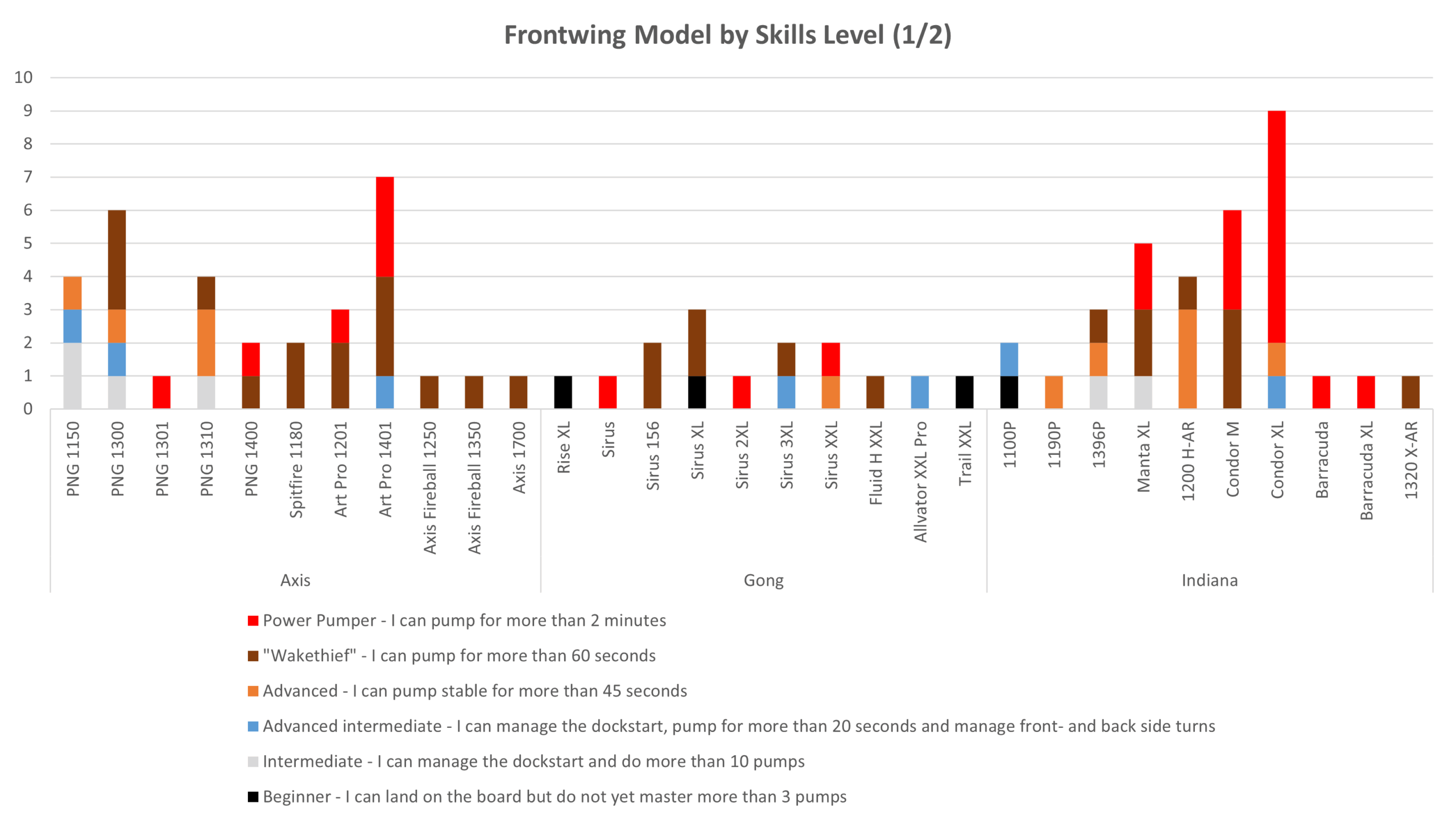
One of the big questions is always, what foil is suitable for a beginner to learn with. There is no right or wrong answer to that as a foil always has to match the riders weight, skills and also personal preferences. But will show you which foils the survey participants are using dependent on if they judge their skills level as beginner or intermediate foiler, means the group of respondents who classifies themselves as „Beginner – I can land on the board but do not yet master more than 3 pumps „ or „Intermediate – I can manage the dockstart and do more than 10 pumps“, as well as advanced pumpfoilers, means that group of respondents that classifies themselves as either „Advanced intermediate – I can manage the dockstart, pump for more than 20 seconds and manage front – and back side turns“, „Advanced – I can pump stable for more than 45 seconds“, „Wakethief“ – I can pump for more than 60 seconds“ or „Power Pumper – I can pump for more than 2 minutes“.
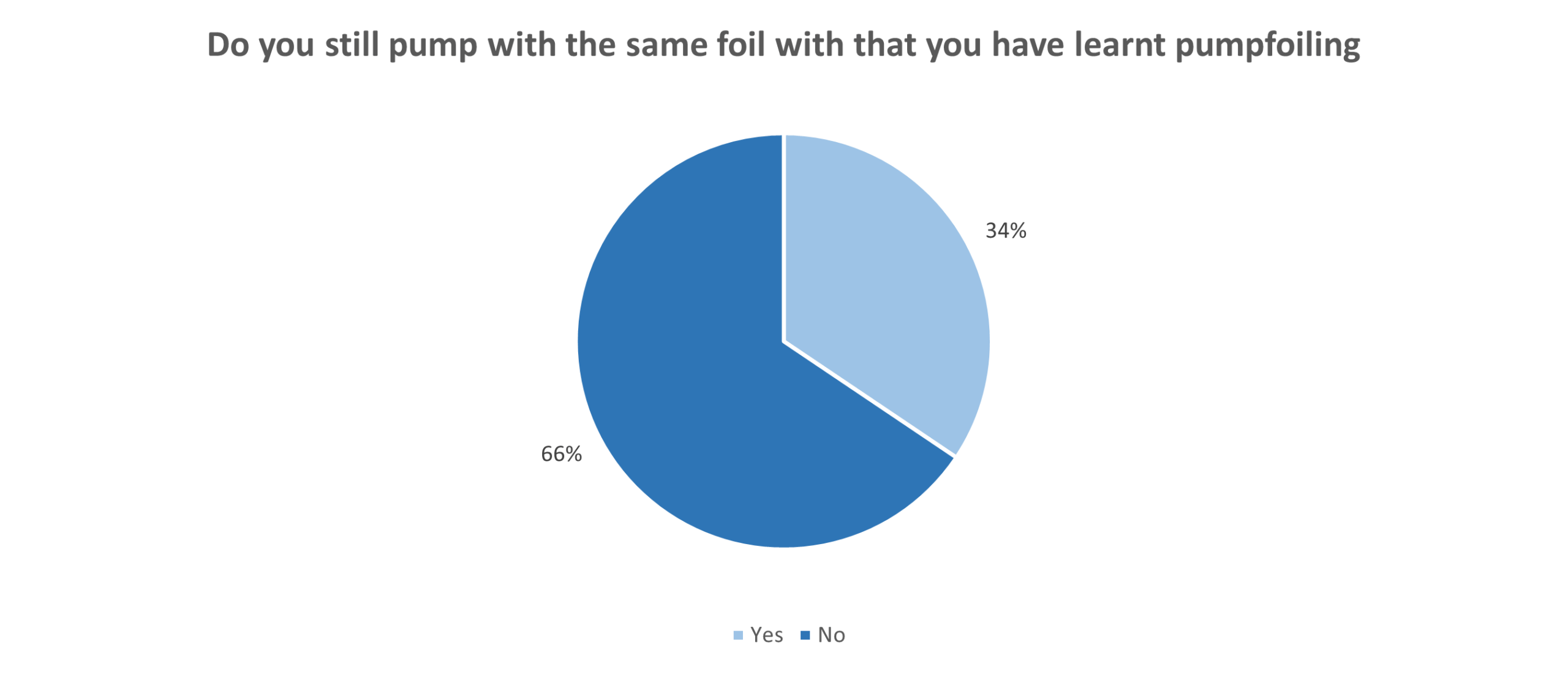
As highlighted in the introduction, pumpfoiling is not anymore a completely new sport. Also many of survey participants have started with pumpfoiling already three or four years ago. Therefore, it is not a surpise, that already 66% have exchanged the foil the started with with another foil.
There can be different reasons why someone is changing the foil. Either, they want to change from a beginner friendly foil to a more advanced foil or they may just realized that the foil they initially bought is not suitable to learn pumpfoiling. Let us see in which learing phase the sruvey participants already have changed their equipment.
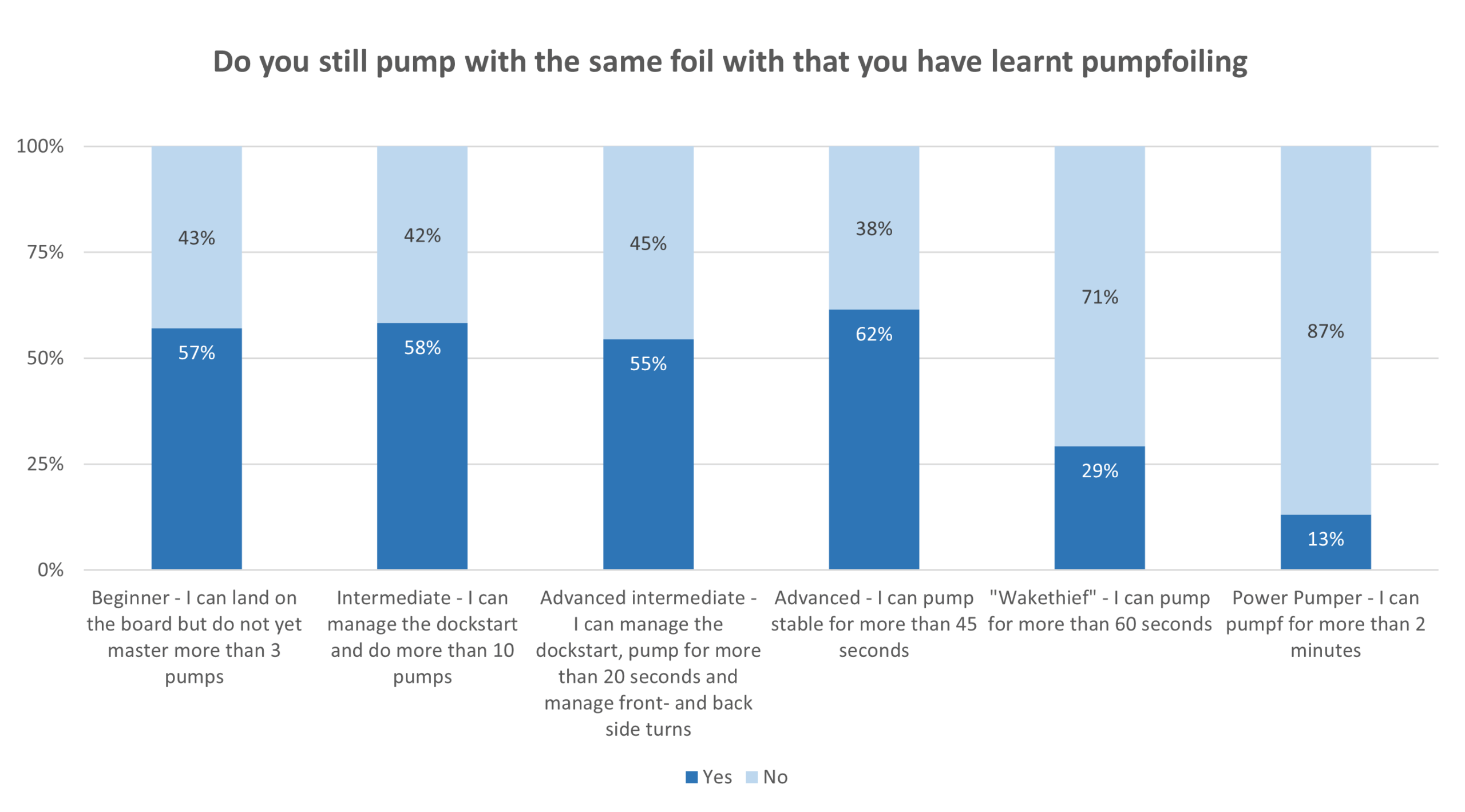
Looking at the result may for many readers quite surprising. It seems that over all levels, there is quite a good amount of people that already has changed the foil. Looking at the percentage of the figures, that is also correct. But we should also keep in mind how much data we could collect. Based on the question How do you rate your pumpfoiling skills? we know that only 9% judge themselves as beginners, or in absolut figures eleven participants. Out of those eleven participants only seven have their own material, hence the represented amount of samples is limited and we will therefore also not disclose which brands/models were mentioned. However, on those results we can see that nearly every second of the beginners as well as intermediate foilers already has changed the equipment and therefore, a good consulting when byuing equipment is important.
Very often beginners ask me, for how long can I use a beginner foil, in case I decide to buy one. Well, there is obviously no precise answer to that question.
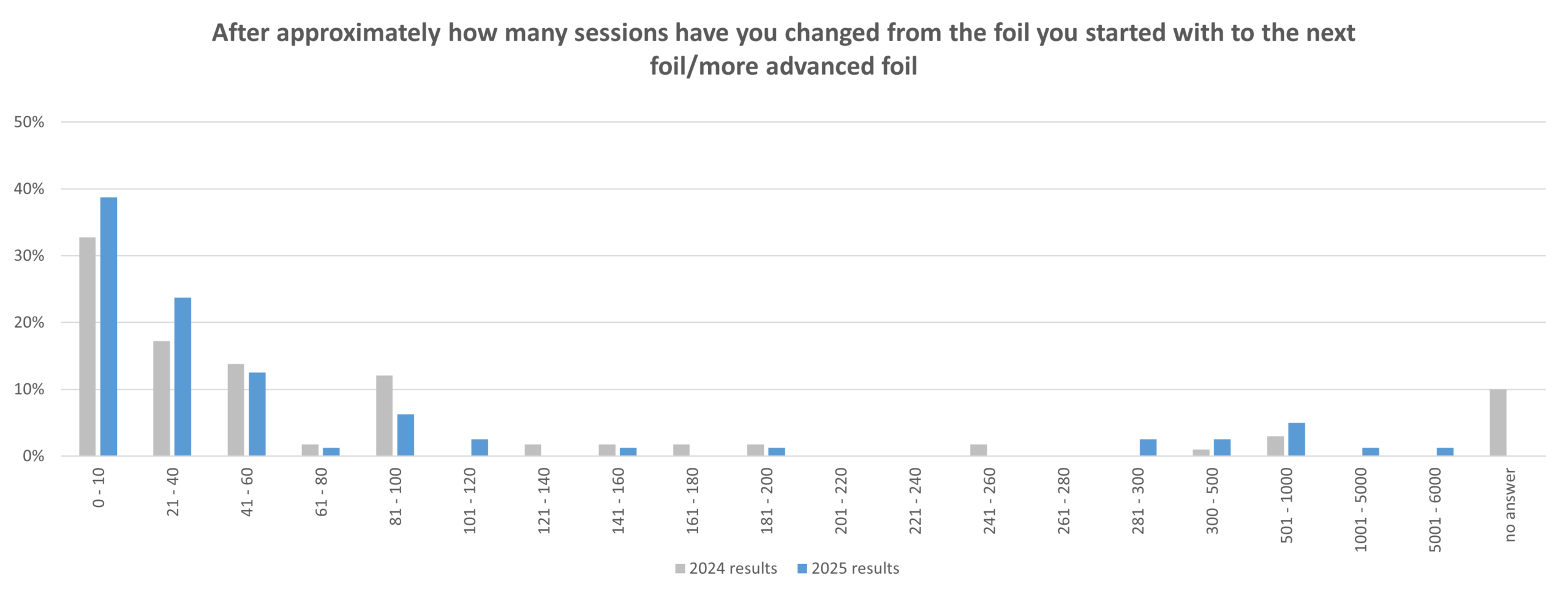
Looking at the results from the survey, we can see that most of the survey participants have changed their foil within the first 12 months.
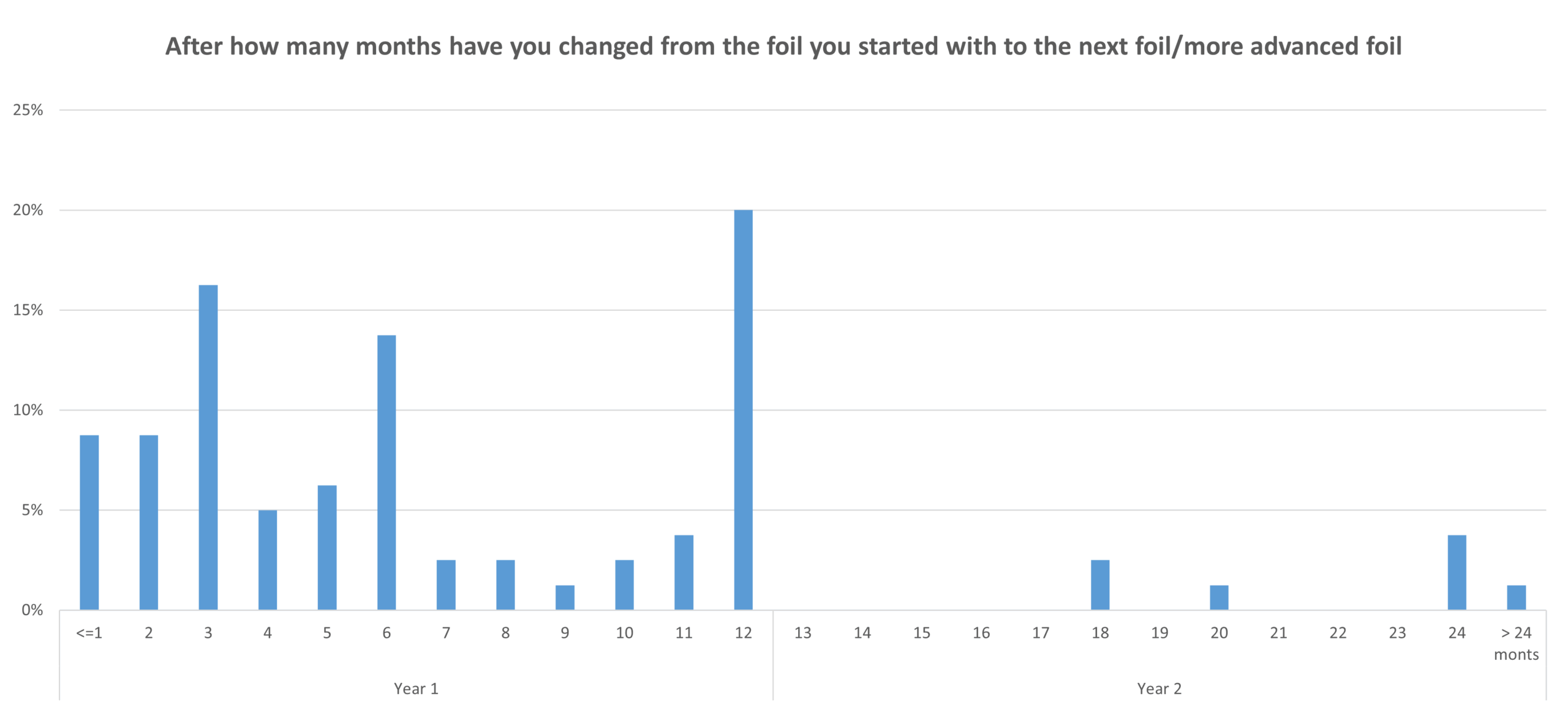
Looking that result, we obviously have to consider that the question „after how many months“ is not considering how often you go pumpfoiling. As we have seen in one of the previous question, there are pumpfoilers who go more or less daily pumpfoiling and others who barely find time to go foiling. Therefore, we asked the same question but in terms of sessions.
Changing the foil, changing the brand?
Foiling equipment is not cheap and when you have to change more than one element, it can become a higher investment. We were curious to see if the responses we collected can lead to a clear picture, if the foilers stay with a brand or if they change the brand when deciding for a new equipment.
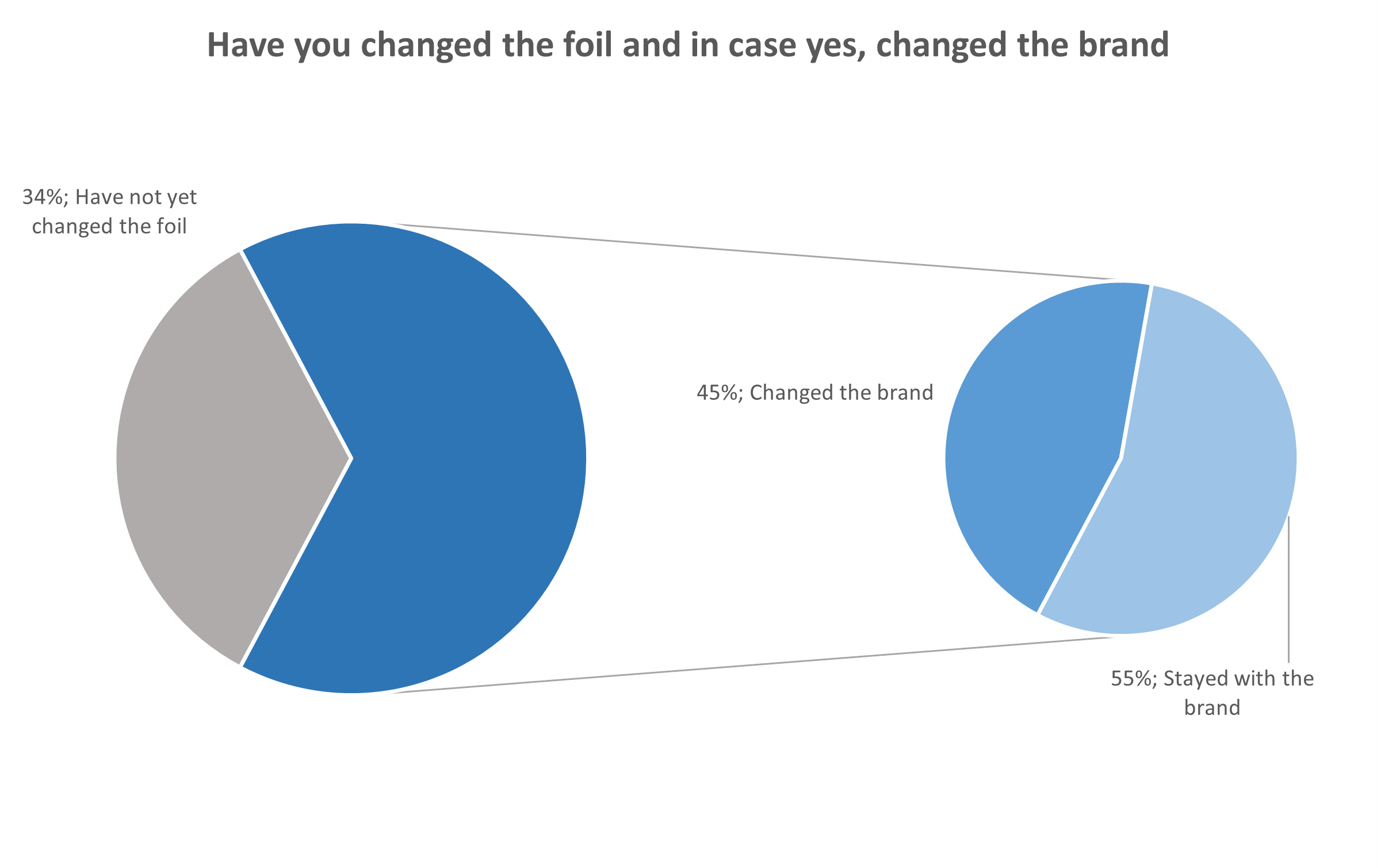
Out of the 66% that already bought a new foil after their first one, 55% stayed with the brand. However, 45% decided for a different brand when deciding for the new foil.
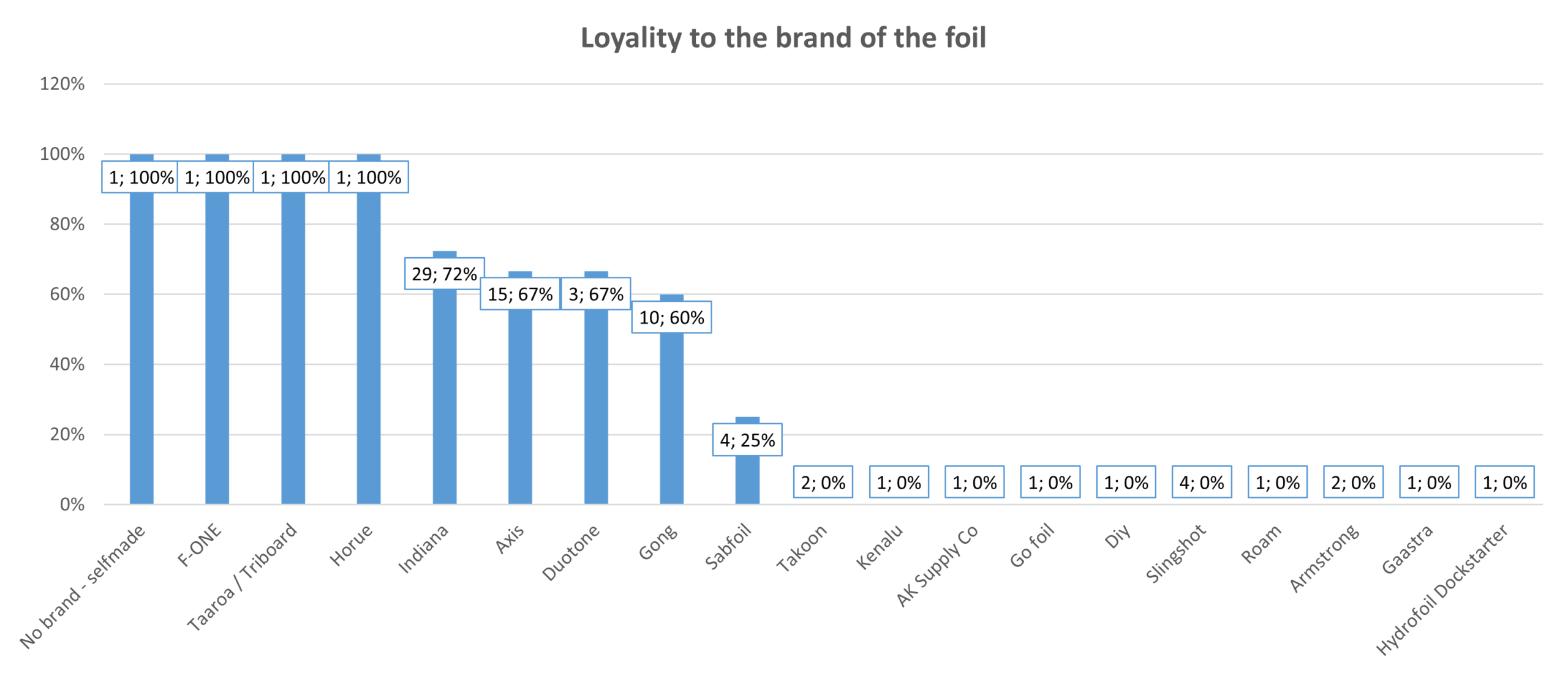
In the following diagram we display the results of the participants who mentioned that they have already changed the foil and if they stayed with the brand. The number in front of the percentage amount indicates the sample size, means that e.g. out of 29 foilers who had their first foil from Indiana, 72% stayed with the brand when deciding for the next level foil.
When talking about buying a pumpfoil set or putting a suitable set together, I am also often asked „what mast length should I go for?“. Well, there is no precise answer to that question and also depends on the personal preference of the rider. You can find some more information about factors influencing the decision for the mast length in the video „Short or Long Mast for Pumpfoiling“.
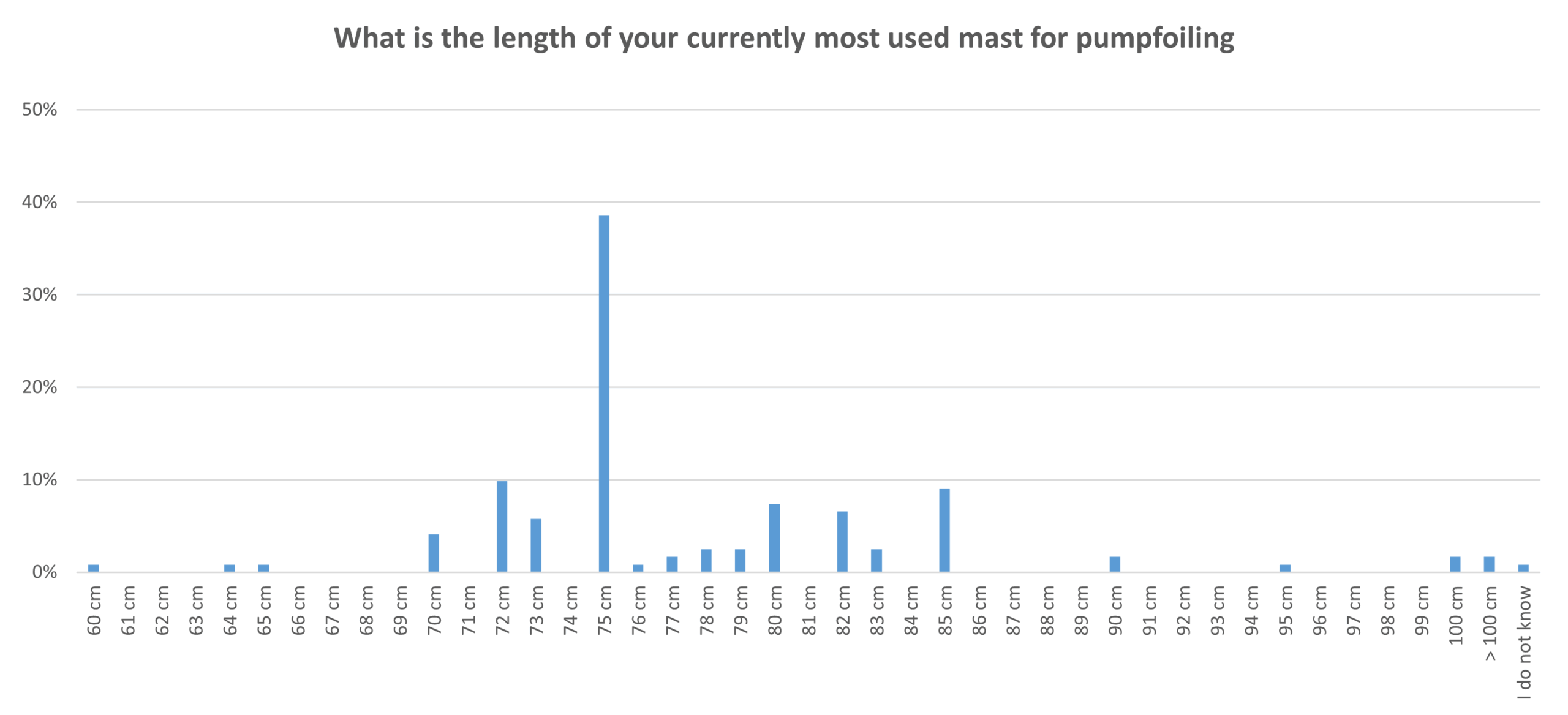
As we can see from the analysis of the results, a majority of the survey participants are using mast length between 72cm and 85cm.
Do our survey participants also practice other foiling sports
Many pumpfoilers do not only practice pumpfoiling, but also enjoy other foiling sports like wing- or kitefoiling. One of the big advantages of pumpfoiling is, that you are not dependent on the wind and e.g. also do not need the space you need to launch a kite.
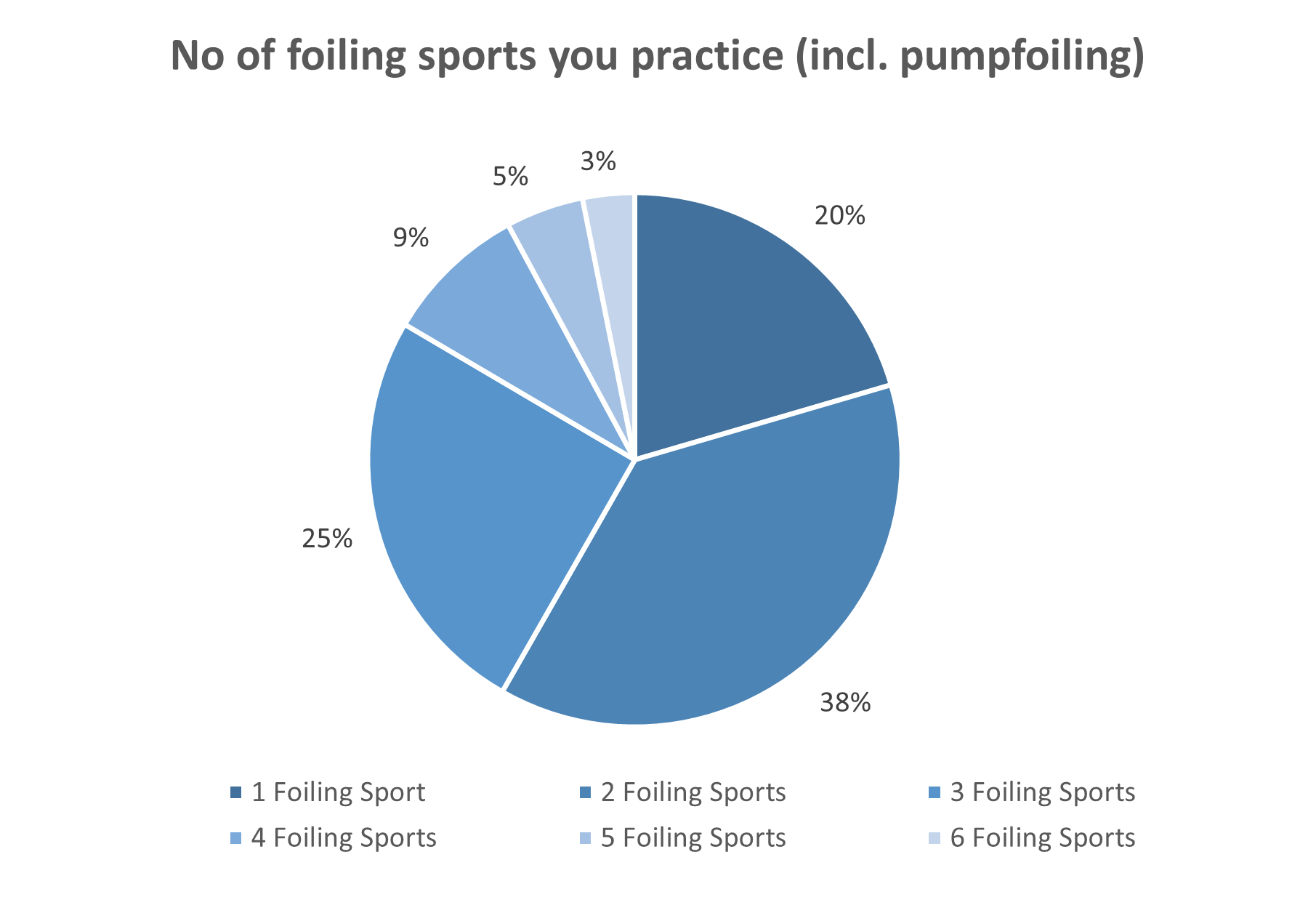
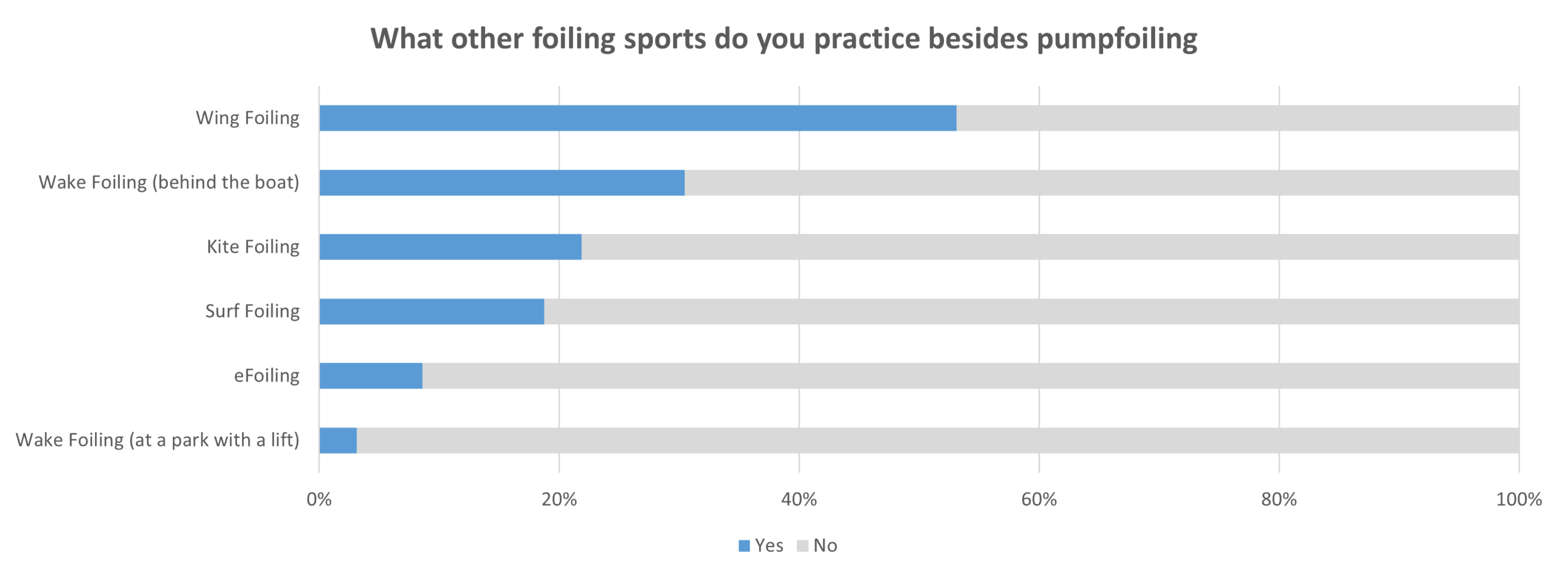
As we can see from the responses of our survey participants, only 20% practice exclusively pumpfoiling (in the 2024 results it was still 30%). The number one sport alongside pumpfoiling (at least for pumpfoilers) seems to be wingfoiling, followed by wakefoiling (behind the boat) and kitefoiling. Around 53% of pumpfoilers mentioned that they also do wingfoiling.
How dangerous is pumpfoiling
Having discussed what it takes to begin pumpfoiling—the challenges involved and the equipment required—there is one more crucial aspect to address: safety.
Like any sport practiced on or near the water, pumpfoiling carries inherent risks. In addition, the equipment itself can impose hazards. Foils are built from rigid materials and often have sharp edges, while boards are far from soft; falling onto them can be painful and may even result in injuries.
Therefore, we felt it was important to include safety considerations in our survey. To start, we wanted to explore whether participants reported using protective equipment during their pumpfoiling sessions.
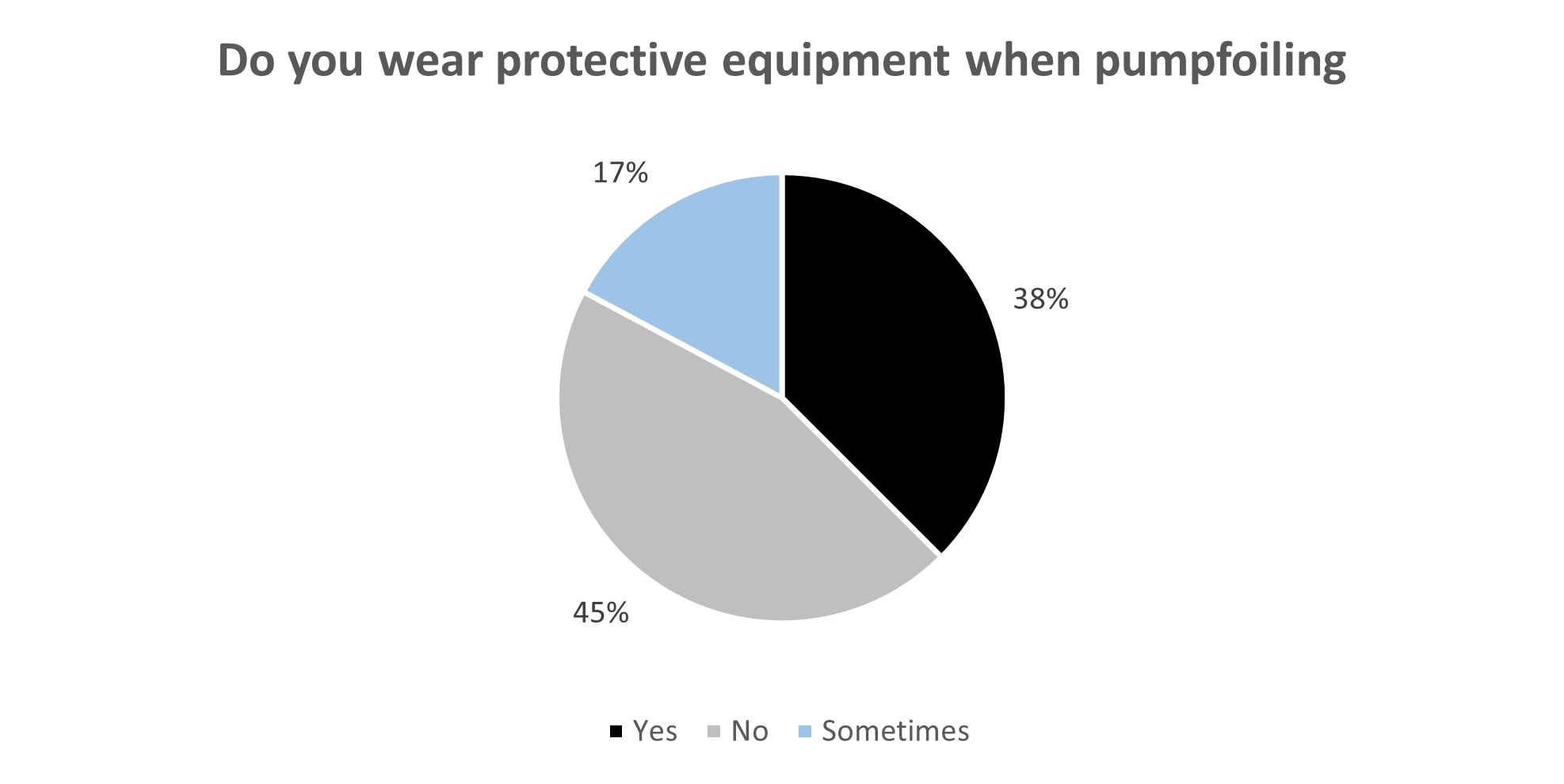
Interesting to see is the change from the 2024 survey results. In 2024 62% mentioned that they always or at least sometimes wear protectors. This years result is lower with only 55% stating that they sometimes or always wear protectors.
Helmet, shoes and wetsuits seem to the be the main protectors people wear.
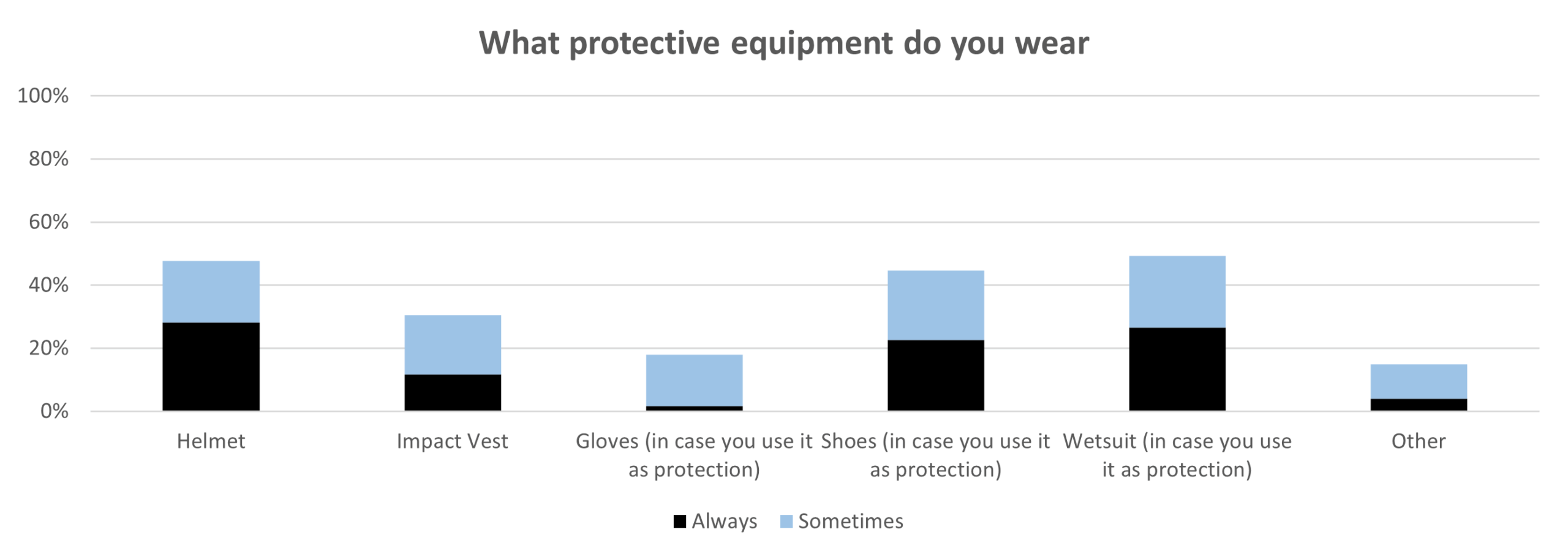
Wearing protective equipment obviously has the goal to avoid injuries, although not every injury can be prevented even when wearing some protective equipment. In 2023 we published an article about how dangerous is pumpfoiling and looked also in the injury frequency rate. In the pumpfoiling survey 2025 we looked again into if accidents happen and in case yes, how severe they were.
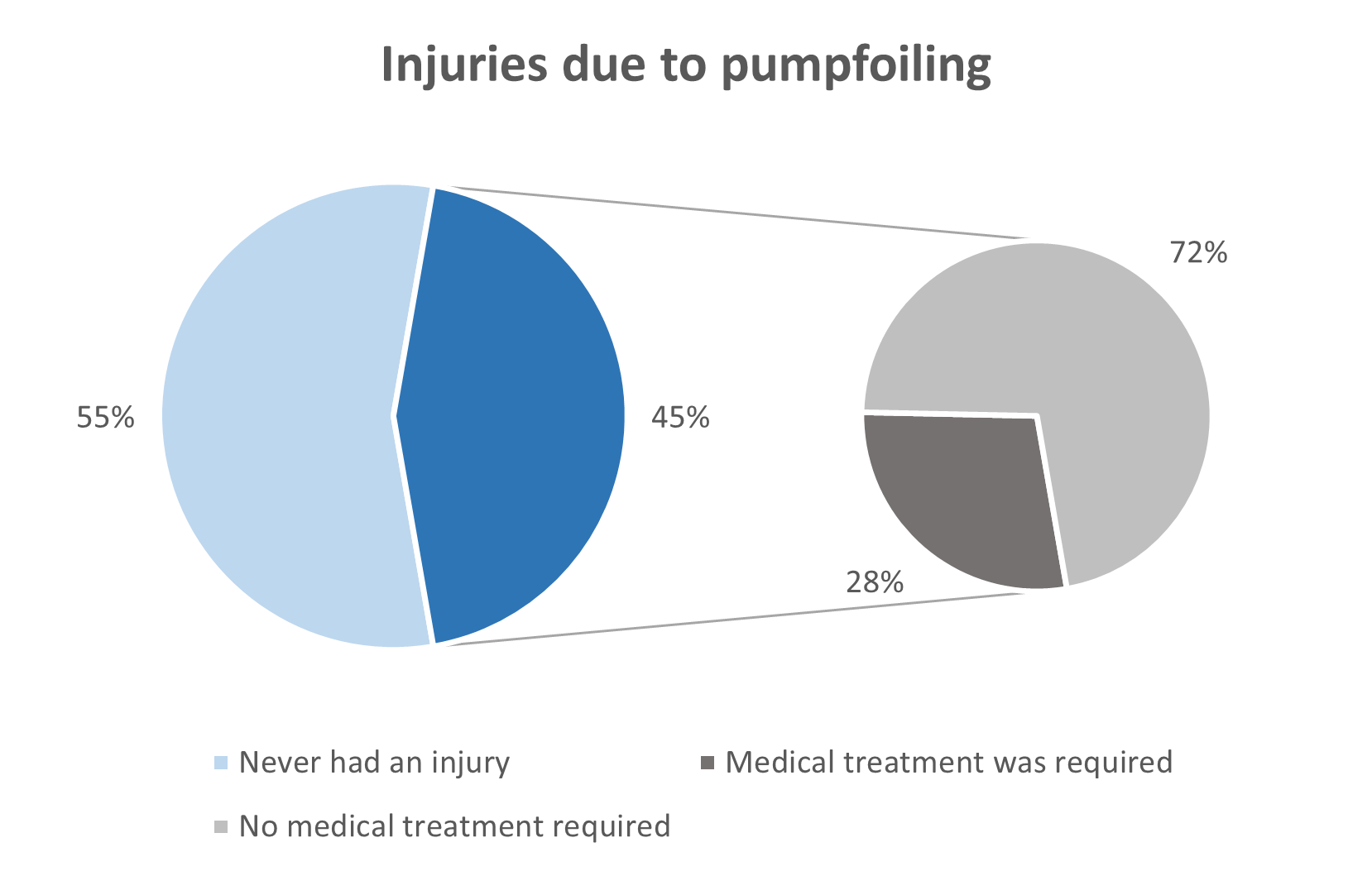
45% already have suffered from an injury. Luckily, a majority of them were minor injuries and only 28% of the injuries required medical treatment.
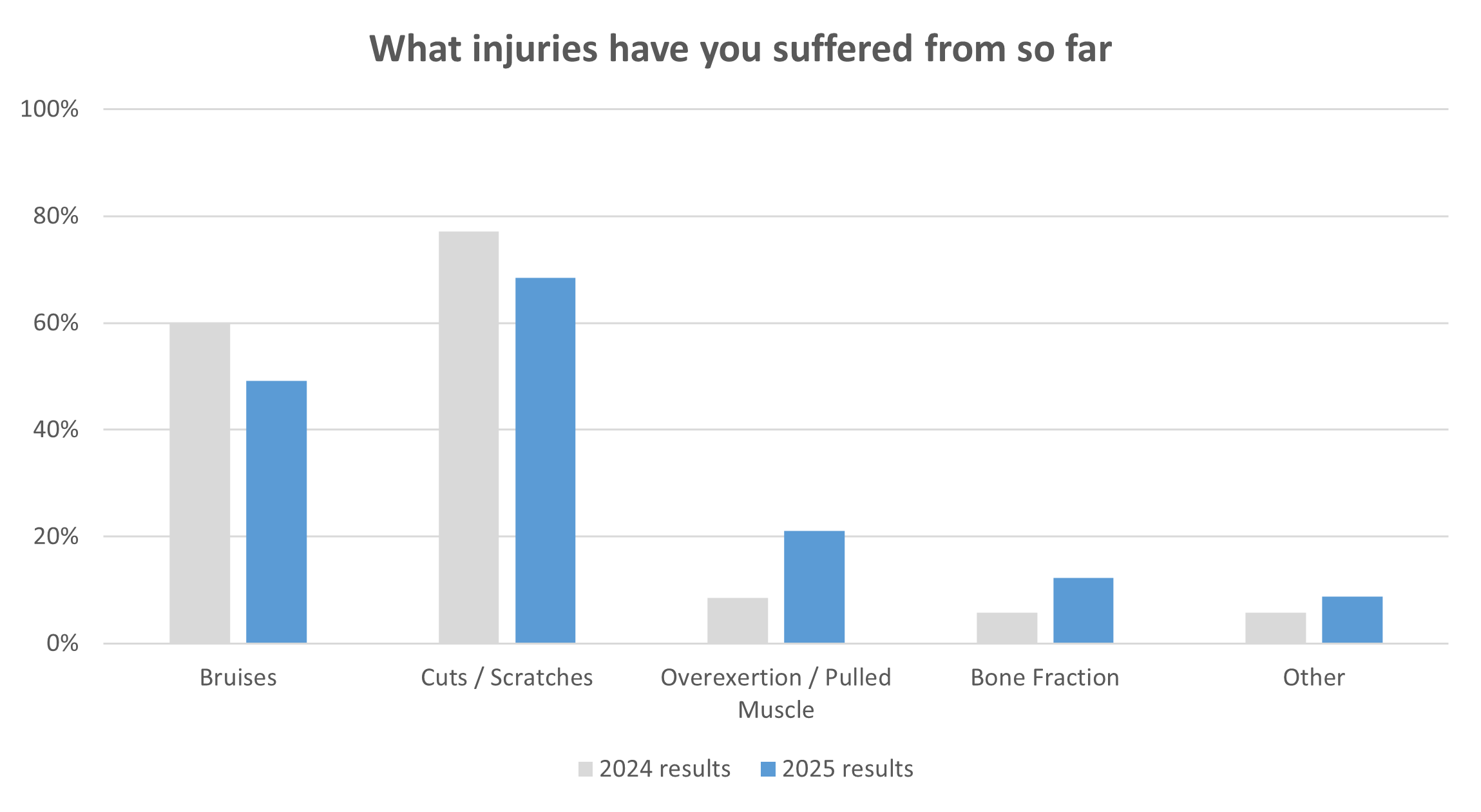
The injury pattern mentioned in 2025 is similar to 2024. Cuts and scratches are same as in 2024 the most often injuries.
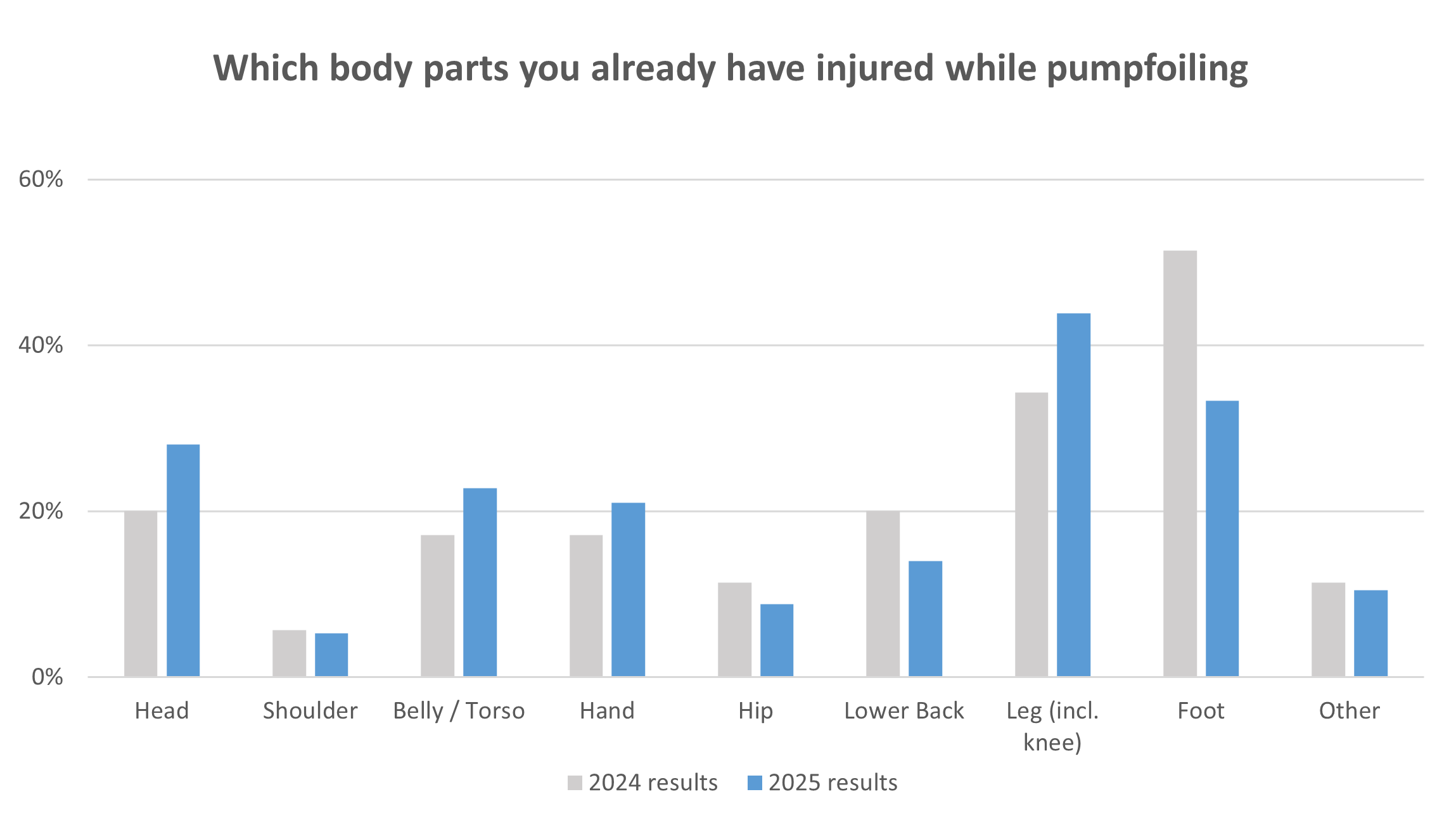
As we can see from the answers legs, feet and head are most affected by injuries. Luckily, most of the injuries are minor.
Looking at the result that already 45% of our survey participants have suffered an injury, it is for sure not wrong to wear protective equipment when pumpfoiling.
Recommendations for beginners
As beginners as well as more experienced pumpfoilers took part in our survey, we were for sure curious to learn from their experience and also asked them, what their recommendations are for newbies who like to or just have started with pumpfoiling. In the following diagram you find their answers. Please note that we could not reflect all feedbacks with the exact wording and had to do some grouping.
Final words
First and foremost, I would like to thank all the participants who generously shared their insights. The purpose of this survey was to foster learning and exchange, core values of any thriving community.
The responses once again highlight that pumpfoiling can be demanding – sometimes even frustrating – but ultimately very rewarding. Progress comes step by step: mastering the landing on the board, the first pumps, turns, and eventually striving toward new personal records for the longest run. Each achievement reflects both the challenge and the joy of the sport.
Just as the sport itself continues to evolve, does the equipment as well. During the recent years, a wide range of new gear has entered the market, which is also reflected in the diversity of materials used by our survey participants. In this survey, we aimed to gain an overview of the equipment currently in use within the pumpfoiling community and, in doing so, provide indirect guidance for those who are just starting out with pumpfoiling.
However, it is important to note, that despite our participants came from many different countries, not all countries/regions were equally represented. This uneven distribution should be taken into account when drawing conclusions from the survey results.
Looking at the questions related to safety, we should be reminded that pumpfoiling is a fantastic sport, but also comes with some risks. The survey has showed that less pumpfoilers are using protective equipment than in the 2024 survey. But it also has shown that quite some pumfpoilers already have suffered from an injury due to pumpfoiling. At the end, everybody has for her-/himself to decide if and what protectors should be used.
The responses related to the question about recommendations for beginners is showing, that pumpfoiling is demanding, but also a lot of fun and that there is a great and supportive community that will be there to support also beginners.
Thanks to all who supported this survey and wish you safe and happy foiling sessions!
We reserve all rights in this article and for the contents contained therein. Reproduction, use or disclosure in third party documentation, also partially, without express authority is strictly forbidden. © 2025, pumpfoilers.ch, contact@pumpfoilers.ch, all rights reserved